Dissenting Report - Australian Labor Party, Australian Democrats
and Australian Greens
Employment
and Workplace Relations Legislation Amendment
(Welfare to Work and other Measures) Bill 2005
Family
and Community Services Legislation Amendment
(Welfare to Work) Bill 2005
1.1
Australian Labor Party, Australian Democrat and
Australian Greens Senators agree with the stated aims of these bills which are
to assist people who are able to work to move from welfare into work . Work is
a fundamental building block of social and economic inclusion. The community
and the individual all benefit when more people are able to participate in the
social and economic mainstream. However, these bills will not achieve this. Not
only is it an incompetent legislative package that fails in its stated aims,
but it introduces perverse incentives that will actively discourage people from
moving away from welfare payments and into paid employment.
1.2
Furthermore, we believe the extremely short period of
time the Committee has been given to hold an inquiry into these bills is
unacceptable. The time-frame was in fact so short that the usual Senate
processes for advertising for submissions could not be undertaken, and
consequently the Committee had to rely on invitation and internet advertising. Within
two weeks, the Committee has been required to dissect and consider the detail
of a long and complex piece of legislation, process and read over 60
submissions, arrange and hear four days of evidence from government departments
and concerned organisations, and produce a report to be tabled in the Senate.
The Committee's report will be tabled in the Senate only five days after
evidence was taken in the last of the public hearings into these changes, which
provides very little opportunity for the evidence to be fully considered.
1.3
Of equal concern to Australian Labor Party, Australian
Democrat and Australian Greens Senators is the limited opportunity
organisations participating in this inquiry have had to consider the
government's package. The National Welfare Rights Network told the Committee:
It has been very difficult to pull this together and to be frank
I do not know how it is going to be possible for the Senate to know exactly
what it is doing when it is carrying this legislation. Even though we have given
it our best bash we are sure we have not been able to fully comprehend what
impact parts of this legislation will have and how they all fit together.[203]
1.4
In the few days they were given, concerned
organisations and individuals have had to very quickly grasp the implications
of a highly complex set of changes and are to be congratulated for contributing
so effectively to this inquiry at such short notice.
1.5
There emerged
a very clear convergence in the analysis offered to the committee by the range
of employment support providers, crisis care services and advocates for the
disadvantaged. All agreed that finding those on welfare meaningful work would
help them improve their lives, but did not believe that the provisions of this
legislation would actually help them to do so. There was a strong consensus
that it would have serious impacts for the disadvantaged that would further
entrench existing inequalities and would lead to a significant longer-term
increase in the numbers living in poverty. Crisis care organizations expressed
serious concerns about their capacity to cope with this increase level of
demand.
1.6
Given the limited
time for this inquiry, we have concentrated our attention on those aspects of
the changes comprised in the bills which were the predominant focus of the
evidence presented to the Committee. There are a range of matters, such as the
changes in respect of mature age and very long-term unemployed, that we have
been unable to properly address in the short time-frame.
1.7
These bills represent the most drastic changes to the
provision of social security in Australia
since the introduction of the Social Security Act in 1947, affecting hundreds
of thousands of the most vulnerable Australians. By so severely limiting the
time frame of this inquiry, the Government has diminished the capacity of
Senators, and the community in general, to appropriately consider the details
of these changes. Given the importance of these proposed Welfare to Work
measures, this should not have been the case.
Fewer incentives to move from welfare to work
From one welfare payment to another, lower welfare
payment
1.8
The core of the proposals comprising the bills is a
reduction in the income support payments of some of our most vulnerable
Australians. From July 2006, these bills effect a reduction in income to many
sole parents and people with a disability. People with a disability will face a
harsher and more restrictive test when claiming the Disability Support Pension
(“the DSP”). Those who are assessed as able to work for 15 hours or more per
week, currently or within a two year period will only be entitled to the
Newstart allowance. Future applicants for the parenting payment single benefit (“the
PPS”) will be moved onto the lower
newstart payment when their child turns 8 (for sole parents, 6 for partnered
parents).
1.9
Not only does Newstart Allowance provide lower rates,
it, has a lower “free” area, is subject to higher withdrawal rates and harsher
tax treatment than both the DSP and PPS. The effect of these characteristics
will be to place people with a disability and sole parents in a substantially
worse financial position than under current arrangements. In addition, they
will face far higher effective marginal tax rates which operate as a
disincentive to work.
Lower
welfare payments for sole parents[204]
1.10
When the Government announced the proposal, its
intention was that sole parents would move to Newstart Allowance when their
youngest child was six years of age the National Centre for Social and
Economic Modelling at the University of Canberra (NATSEM) conducted an analysis
of the proposal on this basis. Since then, the Government has altered the
policy so that sole parents are moved to Newstart when their youngest child is
aged eight years. However, the age difference of the child does not affect
NATSEM's analysis. The financial consequences are simply deferred for the sole
parent by two years.
1.11
NATSEM analysed the proposed payment rate and income
test for new sole parents whose youngest child is aged six years and over is
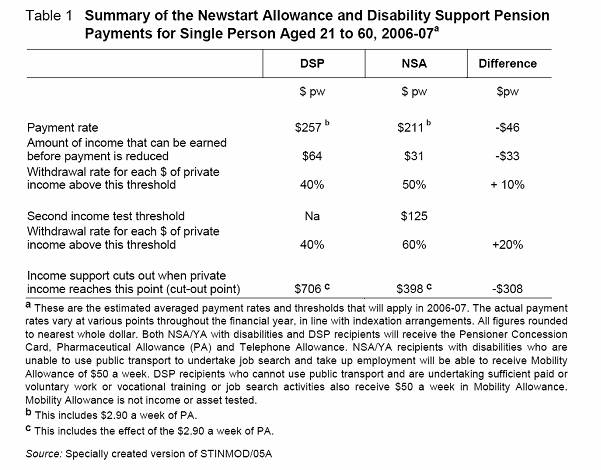
summarised in the following table:[205]
1.12
Sole parents with one child and no private income are
expected to receive about $257 a week on average in Parenting Payment Single in
2006-07. On Newstart they will receive $29 less. A crucial factor is the scope
for combining earnings with part rate income support. In 2006-07, a sole parent
with one child on Parenting Payment Single will be able to earn $76 a week
without any reduction in income support. For those with more than one child the
difference will be even greater, as the ‘free area’ for Parenting Payment
Single is increased by a further $12.30 per child per week for each child after
the first, whereas the ‘free area’ under Newstart Allowance does not vary with
the number of children. For every dollar of income they earn above this
threshold, their welfare payment is reduced by 40 cents. Under Newstart, the
threshold is $31 a week and the withdrawal rate will be 50 and 60 cents per
dollar of private income above the threshold. The tax offset applying to
Parenting Payment Single is more generous than that applying to Newstart.
1.13
The combined effects of these differences means that a
sole parent working 15 hours a week at an assumed minimum wage of $13 per hour,
earning $195 a week will be $91 a week worse off once the parent moves
to Newstart, than under current arrangements. Under the government’s proposals,
this reduction in take-home income will occur overnight, upon the youngest
child’s 8th birthday, when the parent moves from Parenting Payment
to Newstart.[206]
1.14
Parenting Payment provides some financial support for
sole parents earning up to $718 a week while Newstart cuts out at $426 a week.
At those levels of earnings a sole parent will also lose the pensioner
concession card and pharmaceutical allowance.
Lower
welfare payments for disabled people[207]
1.15
The proposed payment rate and income test for
Australians with disabilities that are assessed as being able to work 15 to 29
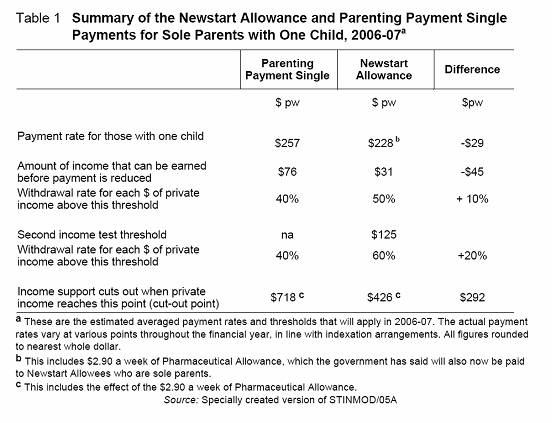
hours a week are summarised in the following table:[208]
1.16
People with disabilities are even more drastically affected
by the changes than sole parents. Single DSP recipients aged over 20 are
expected to receive about $257 a week on average in DSP in 2006-07. The
Newstart rate for a single person without children is $46 a week less. A
crucial factor is the amount of private income that they can receive before
their income support payment is reduced. (‘Private income’ means income from
sources other than government cash transfers, such as earnings.) In 2006-07, a
single DSP recipient will be able to earn $64 a week without any reduction in
the income support they receive, compared with $31 on Newstart. For every
dollar of income they earn above this threshold, their payment from government
is reduced by 40 cents, whereas on Newstart it is reduced by 50 or 60 cents.
1.17
The Newstart Allowance income test is thus much more
restrictive than the DSP income test, and this is reflected in the very
different ‘cut out points’ shown in the table. Single DSP recipients will be
able to earn up to around $706 per week before their entitlement to part-rate
income support is extinguished. People with disabilities on Newstart Allowance
will only be able to earn up to about $398 a week before their entitlement to
income support is extinguished.
1.18
This means that income support will cease at a much
lower level of earnings for those subject to the new Newstart Allowance test
than for those on the existing DSP.
1.19
People with disabilities receiving Newstart Allowance
will clearly receive lower payments and face a harsher income test than those
on DSP: however there are also other, less obvious, factors that will adversely
affect them relative to DSP recipients. One is that DSP is not subject to
income tax. In contrast, both Newstart Allowance and Youth Allowance are
taxable payments. This means that those with earned or other private incomes in
addition to their income support are adversely affected by being placed on
Newstart rather than DSP.
1.20
A second issue is the receipt of the Pensioner
Concession Card. DSP recipients are automatically entitled to a Pensioner
Concession Card, which many organisations use as a ‘passport’ to a range of
concessional prices for such services as property charges and taxes, energy,
water, transport, education, health, car registration, housing and recreation
services and so on. While such services are often provided by State and local
governments, many private sector businesses also use the possession of a
Pensioner Concession Card as the trigger for lower prices for such diverse
services as movie tickets and shoe repairs. Similarly, doctors may often bulk
bill those with Pensioner Concession Cards, so that they do not have to pay any
additional co-payment.
1.21
The Government has stated that those people with
disabilities who are placed on Newstart Allowance under the proposed new
arrangements will retain the right to a Pensioner Concession Card. However, as the
table makes clear, eligibility for Newstart Allowance for people with
disabilities will cease at a much lower level of private income than
eligibility for DSP - $706 versus $398. As a result, there will be many Australians with disabilities, on a range of
private income over $300 per week who would formerly have qualified for the
Pensioner Concession Card, but will apparently not qualify under the new rules.
1.22
It appears that those people with disabilities with
private incomes above $398 a week will not receive a Health Care Card - and
thus will lose their right to concessional pharmaceuticals.
1.23
Those people receiving Mobility Allowance will still
receive a Health Care Card, but some concessions are provided by State and
local governments and other organisations only to those with Pensioner
Concession Cards and not to those with Health Care Cards. In Victoria, for
example, Pensioner Concession Card holders (but not Health Care Card holders)
qualify for an additional municipal rates concession of up to $160 a year and
an additional transport accident charge concession of up to about $170 a year.
Thus, the loss of these three items alone could reduce the effective income of
some people with disabilities by some $6 a week.
1.24
It also appears that the proposed changes will be
particularly harsh for those people with disabilities who are engaged in education
as part of their preparation for future workforce participation. They will be ineligible
for Newstart while undertaking full-time study and will thus be placed on
Austudy. While people with disabilities on DSP receive the Pensioner Education
Supplement, currently worth $31.20 a week for a full-time student, it appears
that this will not be payable to people with disabilities placed on Austudy. Austudy
is paid at lower rates than Newstart, a recipient is not eligible for rent
assistance, and people with disabilities receiving Austudy will not receive the
Pensioner Concession card or pharmaceutical allowance which would be extended
to them on Newstart. Thus, it appears that a person with disabilities in
full-time study and no private income who is placed on Austudy under the
proposed new rules will face a very substantial cut in income (relative to the
payment they would have received under the current system).
1.25
A final issue is that Newstart is much more strictly
asset-tested than DSP. In 2006-07, a single homeowner with assets of more than
$157,000 loses their entitlement to any Newstart Allowance. In contrast, a
pensioner with assets above this level loses $3 per fortnight of DSP for every
$1000 by which assets exceed this level. A 50 year old person with disabilities
who owns their own flat and who has inherited a $200,000 house from their
parents will thus not be entitled to Newstart Allowance, but would be entitled
to DSP and the Pensioner Concession Card under the current system.
No evidence that lower payments increase participation
1.26
Despite receiving over 60 submissions and hearing from approximately
60 witnesses over four days of hearings, the Committee was given no cogent
evidence that a reduction in income support payments will lead to greater rates
of participation in the workforce. The Department of Employment and Workplace
Relations was asked to provide evidence that this reduction in payment would
lead to higher levels of participation. In response the Department has
indicated this was a Government policy decision and subsequently provided
evidence to the Committee that described the effects of policy changes that
differed substantially from the Government's proposals.[209] Therefore they were of no relevance
to the Government’s policy decisions or the Committee's considerations.
1.27
Australian Labor Party, Australian Democrat and Australian
Greens Senators find it extraordinary that the government has taken a decision
to reduce the income levels of so many Australians without providing any
empirical data, nor clear rationale, that such a reduction will enhance
participation. This demonstrates that the central policy change contained in
this legislation – moving people with disabilities and parents onto Newstart,
has no credible justification. In effect, the government is asking the Senate
to support these income reductions without any evidence that they will have a
positive policy effect. The repetition of broad statements of intent to move
people from welfare into work, as is contained in the Explanatory Memorandum,
does not mask the lack of coherent policy rationale for these cuts. We do not
believe such rhetorical reiteration comprises adequate justification for
effecting the harshness of the income reductions for so many Australians that
is contained in this legislation.
1.28
Furthermore, the creation of new categories of
recipients, different levels of payments and different activity requirements as
contemplated by these changes will have the effect of creating a far more
complex and inconsistent social security system.
1.29
The evidence presented to the Committee was
overwhelmingly to the effect that the changes will increase hardship:
[R]educed payments to sole parents and people with disabilities
are unnecessary and counter-productive and will result in increased hardship
for groups already facing significant disadvantage. The Bill
introduces new activity test requirements for people in these groups but fails
to tailor these to individual circumstances and imposes harsh penalties on
those who do not meet them.[210]
1.30
The Department of Employment and Workplace Relations
confirmed that the changes implemented by the legislation, by 2008, will create
171,000 people who will be on lower payments than under current arrangements.[211]
Other disincentives
1.31
This package makes it harder for people to get
assistance and the payments that they do get will in many cases be lower than
the current regime. We note the evidence from the St Vincent de Paul Society
that these bills, in combination with the industrial relations legislation,
will see an increase in poverty levels in Australia
and significant growth in the number of working poor.[212]
1.32
We note that the government’s policy decision to alter
the budget announcement so that sole parents are moved to Newstart when their
youngest child is aged 8 years rather than 6 years as originally announced, simply
confirms the lack of policy logic in this package. Further, the package
introduces greater inequity into the welfare system where two people in
identical situations are treated differently. The following example
illustrates:[213]
Cancellation
due to earning additional income
Sally and Claire are in identical situations. They
share a house and both have a seven year old daughter. They receive Parenting
Payment (single) and work 15 hours a week in a minimum wage job at the
local childcare centre, earning $200 a week in private income, with a total
income of $390 a week from both PPS and work.
In July 2006, Claire picks up additional hours at the
childcare centre and as a result of the additional income her Parenting Payment
(single) is cancelled. In November 2006, the childcare centre downsizes and
Claire's hours are reduced back to 15 hours a week.
Under the proposed legislation, Parenting Payment
will be abolished for new applicants whose children are over eight from 1 July
2006, and the lower Newstart Allowance payment rate and harsher income test
will apply. As a result, Claire will receive only $322 a week - $68 a week less than
Sally.
Two sole parents in identical situations will receive
different amounts of financial support to look after identical families. One
will receive around 16% less income than before the changes because she
accepted additional work which only lasted five months (ie. more than the 12
week gap allowed before payment is cancelled).
Sole parent
families
1.33
Evidence shows that sole parent families have the
lowest level of household wealth and experience higher levels of poverty
compared with other families.[214]
While the proportion of sole parents in paid work has increased over the last
twenty years and they have the highest rates of paid employment amongst all
welfare recipient groups, they experience significant barriers to undertaking
work, despite their desire to do so. These barriers include the following:
-
mental health difficulties due to the demands of
being the only carer, having a low income, and coping with relationship
breakdown. Forty-five per cent of sole parents receiving Parenting Payment
(Single) have a mental health problem such as clinical anxiety or depressive
disorders—higher than for all people on other benefit types;
-
lack of affordable, flexible and high quality
child care, including occasional care and after school care. Sole parents are
more reliant on non-parental child care and have higher average child care
costs than two-parent families, so they are particularly vulnerable to the declining
levels of availability and affordability; and
-
low levels of car ownership, and inadequate
public transport with timetables and routes which do not allow parents to drop
off children at school and then go on to work.
1.34
Employment during school hours is sometimes not
available; and some jobs require people to work nights or weekends when
centre-based child care is not available. Unskilled jobs are often casual,
requiring staff to be on call—but child care is not available at short notice.
Tax disincentives
1.35
Sole parents face high effective marginal tax rates
(EMTRs): for every dollar they earn from working, they may lose more than 60
cents from benefits and family payments. Currently around half of sole parents
with earnings face high EMTRs, whereas 90 per cent of Newstart recipients with
earnings face high EMTRs. When sole parents are transferred to Newstart and
find casual or part-time work of at least 15 hours, a greater proportion
will face high EMTRs.
1.36
Different EMTRs apply across different ranges of additional
earnings. However, to take one example, a sole parent’s additional earnings on
Newstart between $31 and $76 will be affected by an EMTR of 65 per cent rather
than the zero per cent under the current system. This means they will only gain
35 cents of each additional dollar that they earn in this range. By adding in
the cost of child care they keep even less from their earnings.
Transitional arrangements
1.37
We are concerned about the transitional arrangements or
the savings or grandfathering provisions for the parenting payment. Given the
significant difference between payment levels for people who get to stay on
Parenting Payment Single and those who end up on Newstart Allowance as primary
carers, the legislation does not provide adequate safeguards to ensure that
people currently on parenting payment will retain the payment until the
youngest child turns 16. The promised savings provisions would appear to be far
more restrictive than indicated on budget night and since, and will only apply
to those parenting payment recipients who are covered by the transitional
arrangements.
1.38
Under these arrangements, virtually any change in
relationship status will cancel out any right to return to the original
parenting payment:
I would have thought that we wanted to encourage reconciliation
of former partners—fathers with their children—and to encourage people to go
out and earn. That is supposed to be the thrust of the legislation. But, if you
do so, you are off parenting payment single if you are off for more than 12 weeks...12
weeks is not in the legislation in either of those two examples. We think that
these narrow provisions may well turn out to be, in fact, extremely
counterproductive and create disincentives in people’s attempts to repartner,
reconcile or look for work.[215]
Parenting Payment Activity Agreement
1.39
There are serious deficiencies in the legislation as
concerns the parenting payment participation requirements. A Parenting Payment
Activity Agreement will set out the activities the Secretary of the Department
considers a person should undertake in order to remain qualified to receive
payments. We have a number of concerns about the provisions surrounding these
Agreements, including:
-
the removal of the requirement that the
Secretary gives written notice of a requirement to enter into a Parenting
Payment Activity Agreement (501(5));
-
the requirement that a person must comply with
the terms of their Parenting Payment Activity Agreement (500A(b)). The current legislation states a person must
take 'reasonable steps to comply' (see s501(2));
-
the removal of a list of 'approved activities'
for Activity Agreements, that currently exists in the legislation. The list
provides a legislative safeguard, outlining a range of activities that are
appropriate to include in Activity Agreements;
-
the provision that states that if an Activity
Agreement requires a person to look for part-time work, they must look for work
of at least 15 hours per week or hours determined as appropriate by the
Secretary (501B). The Explanatory Memorandum
explicitly states that a person will not be required to look for work or accept
work where the work would involve more than 25 hours per week. Unfortunately
there is no legislative protection of the 25 hours as this figure has not been
included in the legislation; and
-
the provision that requires a person to
undertake particular paid work, unless the Secretary is of the opinion that the
paid work is unsuitable (502(1)). Section 502(4) prescribes in what
circumstances work will be unsuitable. For example, work will be unsuitable for
a person if the person does not have access to appropriate care for their
children (s502(4)(c)). We are concerned that s502(5) dictates that if the
Secretary decides the person has access to appropriate child care, then no regard
need be given to whether the parent considers the care to be appropriate for
their child. Further, whilst the Explanatory Memorandum states that the
Secretary will bear in mind the cost of child care and accessibility when
making a determination as to the appropriateness of the child care, this
protection is not provided in the legislation.
1.40
The availability of child care is another factor that
needs to be considered as part of the Parenting Payment Activity Agreement. In
the legislation, appropriate care and supervision of children is deemed to be
met by any of the following:
(a)
care provided by an approved child care service and the
Secretary considers that the care would be appropriate;
(b)
care that the principal carer considers suitable and
could be provided to the child (i.e. informal care by
family/friends/neighbours); and
(c)
child attending school and that, in the Secretary’s
opinion, is appropriate.
1.41
We are concerned with these provisions for the
following reasons:
-
a delegate of the Secretary has no qualifications
to determine whether child care is appropriate;
-
children may be forced to move between child
care providers and thus be denied continuity of care;
-
children may be forced to move schools;
-
principal carers can be forced to undertake
activities when only informal care may be available – this is too great a
burden to place on the carer and support network. Furthermore, it cannot be
assumed that an informal carer can always be available when required. This will
place inordinate stress on children, principal carers and their support
networks.
-
any requirement to undertake activities during
school hours must include time allowed to travel to and from school, as well as
the venue where the activity is to take place; and
-
deeming school as suitable child care does not
take into account pupil free days, school holidays, public holidays.
-
parents may have difficulty in accessing
appropriate vacation care, particularly in rural and regional areas
1.42
While the legislation provides for exemptions from
participation requirements for people in limited circumstances and for
restricted periods of time, there are problems with some of these.
The various exemptions to activity requirements that are meant
to be embedded in the legislation are not in many cases, and the ones there are
inconsistent as they are presented in the legislation. Who gets exemption and
who gets the top-ups if you are exempt? Despite the acknowledgment that you
cannot work or look for work because of your circumstances and therefore will
not be able to get work and the money that goes with it, only some people get a
top-up. Others do not get that top-up. These are inconsistent and incoherent
provisions that seem to have been hastily drawn up and inserted at the last
minute in response to what we consider to be valid political concerns.[216]
Families are treated inconsistently
1.43
Labor, Democrat and Greens senators are concerned by the
inconsistency as to activity requirements and income support levels for parents
contained in this legislation, and alluded to in the above evidence. The
government has determined to provide automatic exemption from the move onto
Newstart for certain specified categories of parents being home educators,
those engaged in distance education and foster carers. Parents within these
categories are not only automatically exempt from participation requirements,
they are also eligible for a top-up payment to restore their immediate income
level to the PPS level.
1.44
While we agree there is a strong policy argument for
such exemption and top-up in relation to parents in these categories, we
consider equally strong arguments exist in relation to parents in other
circumstances. Why, for example, will a victim of domestic violence have to
seek an exemption on a temporary basis, whereas a home educator will attain an
automatic exemption?
1.45
Furthermore, parents who achieve a temporary exemption
from activity requirements due to circumstances such as domestic violence or
homelessness will not be eligible for a top-up payment. If the rationale for
the top-up payments for the automatically exempted categories is that their
circumstances prevent them from working, surely this applies equally for a
parent who is unable to work because of an experience of domestic violence? We
regard the Government’s approach to exemption and top-up payments as lacking
policy rationale and consistency.
1.46
We further note that the top-up payment will not
protect the exempted categories of parents from a worsening of their financial
position. Due to the difference in indexation applied to Newstart allowance,
over time it is inevitable that their payment levels will decline relative to
what they would have been had they been retained on the parenting payment. In
addition, the substantially higher effective marginal tax rates faced by Newstart
recipients create substantial financial disincentives should these parents
engage in any part-time work. We see little policy logic in this position.
1.47
We also note these bills alter the point at which a PPS
recipient will move onto Newstart from that announced in the May Budget. The
relevant age of the youngest child has moved from 6 to 8. We make the point
that the same concerns regarding the financial position of these vulnerable
families which underlies this change remains true for families whose youngest
child has turned 8.
People with
disabilities
1.48
The proposed changes to the Disability Support Pension
(DSP) are likely to reduce income for people with disabilities. The change in
eligibility means that 60 per cent of new applicants for DSP will be rejected,
compared with 40 per cent at present. About 26,000 people per year will go onto
another benefit (mainly Newstart Allowance). Single people will be at least $40
per week worse off.[217]
1.49
Those on Newstart will also face harsher taper rates of
50 per cent or 60 per cent rather than 40 per cent under the DSP. This means
that a person working 15 hours per week on Newstart, for example, will be
$93 per week worse off than if they were on the DSP and working the same hours.
1.50
Furthermore, by redefining 'educational or vocational
training or on-the-job training' in paragraph 94(3)(a) of the Social Security Act 1991, the bill will
make it very difficult for a person to qualify for Disability Support Pension. This
is because the bill inserts a much wider definition into the Act so that where
a training activity would enable a person to find work some time in the next
two years, then that person is ineligible for DSP. As noted by Mr Michael Raper
of the National Welfare Rights Network:
The majority of people with disabilities, even those with a
severe disability, would be able to undertake a training activity, given its
broad definition in section 94(5) of the bill. They would be able to undertake
a training activity if it were available and locally accessible. In many cases
this could lead to work of at least 15 hours.
The problem is, however, that without that training activity,
they have little or no capacity to work, and that training activity is
unavailable to many people, particularly in rural and remote communities. If
the training is not available, they will not be able ultimately to qualify for
the disability support pension.[218]
1.51
The insertion of new section 94A into the Act
introduces an alternative means of qualifying for Disability Support Pension.
However, it does not address the issues for people with disabilities who do not
have access to a 'training activity' in their locally accessible area.[219] It introduces a “Catch-22” situation
as illustrated by the following situation:
Basically, for eligibility for Disability Support Pension, they
will have to assess whether, if you got some disability specific training, it
could maybe get you a job in the next few years—if you have, for example,
cerebral palsy and they gave you training that could help you work that specifically
addressed that disability. If it could, then you are not going to get
Disability Support Pension at the moment. That is how the legislation reads:
‘We will put you on Newstart at the moment, and the theory is that you will do
the training for two years that we have identified would be great for you and
if, at the end, you still can’t work 15 hours a week or more you go onto
Disability Support Pension.’[220]
1.52
By transferring people to the Newstart Allowance if
they are assessed as being capable of working for at least 15 hours per week,
the legislation, contrary to its aims, puts people in a position where they
would be encouraged to understate their capacity to work. Many people have
significant costs associated with disability and are likely to be in a far more
precarious financial position than those without disability. This creates a
strong perverse incentive for them to qualify for DSP rather than the lower
payment of Newstart.
The minister reports that 82 per cent of jobless disability
support pensioners would prefer to work, and I do not doubt that that is true.
But if you are faced with the financial consequences of being assessed as able
to work 15 hours or more and lose the pension, you face what is called a
perverse incentive, which is not to risk overstating your capacity to work
because of the desperate need to qualify for the pension, which at least
provides some security.[221]
1.53
Ms Julia Perry submitted that the proposals to move DSP
recipients onto Newstart instead of applying the activity test to them will
recreate a 'welfare trap' and strong disincentives to work that were features
of the Invalid Pension (the pre-cursor of the DSP).[222] The replacement of the Invalid
Pension with the DSP was intended to overcome these problems where pensioners
had a strong reason not to risk testing their capacity to work in case they
lose entitlement.
This is not just notional; this is exactly what happened under
the old invalid pension. I was in the disability policy area just subsequent to
1991. [Invalid pension] required less than 15 per cent capacity and anyone who
tried to test their capacity to work risked losing the pension. They were stuck
in what is called a welfare trap. The disability support pension was brought in
specifically to overcome that welfare trap and to give people some chance of
testing their capacity. If you applied the activity test to people on
disability, they would have nothing to lose and a lot to gain by testing their
ability to work. But the plan to go back to this invalid pension style
restriction is going to backfire if the government wants to see more people
come into employment. That, to me, would be disastrous in terms of helping
people to get on the road to full independence.[223]
1.54
There are also problems in assessing disability. Ms Perry
told the Committee that this area is the most imprecise of all decisions in the
income support system and the largest source of appeals to the Social Security
Appeals Tribunal.[224] It involves not
only assessing current impairment but predicting the future of a person's
condition over the next two years, estimating the potential effects of
education, training and rehabilitation and rating that against a person's
ability to undertake any sort of work that exists in Australia now and for the
next two years.
1.55
The Comprehensive Work Capacity Assessment (CWCA)
estimates people's capacity to work certain spans of hours per week (ie 0 to 7
hours, 8 to 14 hours, 15 to 29 hours and 30-plus hours), now and into the
future. The level of uncertainty in making those decisions is not compatible
with making accurate specifications in all of the fine bandwidths that are
required. Ms Perry
contends that the assessments will not reflect reality.[225] We are concerned because the
consequences of incorrect assessment are so great for individuals under this
legislation. Around 370,000 people will undergo assessments in 2006-07.[226] Even if the error rate is only 3 per
cent, more than 11,000 assessment or referral decisions will need to be
rectified.
Changes to
Newstart Allowance
1.56
Given the significant increase in the number of people
who will be in receipt of Newstart Allowance as a result of the changes to the Disability
Support Pension and Parenting Payments, there are a number of proposed changes
to the Newstart Allowance that concern us.
1.57
The introduction of RapidConnect imposes obligations on,
and requires people to undertake activities
before they are even on a payment. This means that as soon as a person either
lodges a claim or contacts Centrelink with an intention to claim, they can be
required to attend an interview with a specified person or organisation at a
time and place specified in the requirement and/or be required to enter into an
activity agreement. According to Mr Raper from the National Welfare Rights
Network:
In all our experience, clients do not understand any
requirements, activities or anything that is being sought to be imposed on them
until they have their income sorted out. They generally leave it while trying
to struggle off their own incomes. When they become unemployed or their
circumstances dictate that they need to go on payment, all they need is to get
on payment. It is not the right time to tell them about their activity
requirements or what is going to happen to them if they do not fulfil them.
RapidConnect may seem desirable but, in our view, imposing requirements on
people before they are even on payment is absolutely fraught with difficulties...[227]
1.58
For a person who is in receipt of the Newstart
Allowance, the legislation removes the ability to negotiate the content of
their activity agreement. Rather, the activity agreement will require the
person to undertake one or more activities that the Secretary regards as
suitable for the person. The Secretary's discretion in this matter is only
limited by new subsections 606(1A) and (1B) which prevent certain requirements from
being included in agreements. These prohibited requirements are to be included
in a legislative instrument. According to Mr Raper, this situation is
unsatisfactory:
The proposals leave only a non-legislated document to determine
what a person should not be reasonably compelled to undertake. It seems to be
coming at this backwards. We are going to set out in a legislative instrument
what a person may not be reasonably required to undertake. How comprehensive is
that list going to have to be? It seems that it would be far better to move
back into the legislation the list of things that are currently in the
legislation as to what can be reasonably and legitimately required of a person.[228]
This report considers the use of legislative instruments in
more detail in a later section.
Failure to
encourage and support skills acquisition
1.59
Having an appropriate set of job-ready skills is vital
to a job seekers' prospect of successfully finding employment. Unfortunately,
the majority of welfare recipients have a low skills base. The Government's
proposed measures serve to move a large number of relatively unskilled (or with
skills that are outdated) Parenting Payment and DSP recipients into the job
search market without offering adequate opportunities for them to update their
skills in order to be ready for the workforce.
1.60
In its submission to this inquiry, the Brotherhood of
St Laurence highlighted the disparity between the Bill's intent and the
realities of labour market competition:
We need to build the capacities of those least able to compete
in our modern economy and ensure they are able to live with common dignity
whilst we do. Without measures of this type we find no vision of a fairer
society in what the Government is proposing.[229]
1.61
Under these proposed changes, parents and people with a
partial capacity to work will be forced to look for 'suitable employment' in
order to meet their activity requirements and receive their Newstart Allowance.
However, this does not recognise that many of these people are lacking the
skills to find such employment. According to the National Welfare Rights
Network:
People who have dependent children or a disability may have been
out of the workforce for some time and or have additional barriers to obtaining
employment. Making these people solely look for work in order to comply with
their activity agreement without allowing other types of activity, such as
training, will be counterproductive. If people are not currently employable,
making them seek work could be demoralising and pointless and will in no way
improve their workforce participation. There needs to be a recognition that job
search should not be the only activity that would meet the activity test.[230]
1.62
Before welfare recipients that have potentially been
out of the workforce for many years are forced to seek employment, their
capacity for successfully doing so needs to be improved.
1.63
Sole parents have lower rates of formal education
compared with coupled parents, with half having finished school at Year 11 or
earlier. Sole parents are also less likely to have post-secondary education and
may lack the qualifications for many jobs. Three-quarters of sole parent
mothers have no post-secondary qualifications, but the proportion increases
gradually so that by the time their youngest child is 15 years old they are
just as likely as coupled mothers to have a degree. It is clear that they use
the time from when their youngest child starts school to undertake further
education.
1.64
Ms Julia
Perry, former Director of Disability Policy
and Director of Sole Parent and Family Policy in the Department of Family and
Community Services, told the Committee that of those on the Disability Support
Pension, a high proportion did not complete Year 12 or have post-secondary
level education. She stated:
This is a disadvantage in the labour market, particularly for
those who are incapacitated for manual work. The labour market is suffering
from skills shortages and requires higher education levels among the potential
workforce.[231]
1.65
During this inquiry, the Committee was informed that
the Bill fails to provide adequate mechanisms to ensure that those entering the
job search market are able to sufficiently build their capacity to be ready for
employment. Critical to this failure is the activity requirement focussed
entirely on seeking 'suitable employment', where a period of part-time study or
training would often be more beneficial to a person's employment prospects.
1.66
For sole parents or people with a partial capacity that
wish to improve their skills through study, there are no viable options
provided by these bills. Austudy is available for full time study only (except
for people with substantial disability) and cannot provide an income supplement
to parents who are only able to undertake part-time study. This disincentive is
exacerbated by the fact that Austudy represents a lower level of assistance
than Newstart, and is intended to contribute to the cost of textbooks and other
costs of education. It is also critical to note that in being moved to
Newstart, sole parents lose their access to the Pensioner Education Supplement
(PES) that supports many through the process of improving their qualifications
and work-readiness. When the Department was asked to explain why PES would not
be available for sole parents and people with a partial capacity on Newstart,
their response was that it was only available to pensioners. This is an
inadequate rationale, and ignores the fact that these people will retain other
pension-specific benefits such as the Pensioner Concession Card.
1.67
In this package, the government has announced
employment assistance measures (through the Employment Preparation Service) to
improve the skills of those that will be required to seek work. However,
evidence received by the Committee indicated that this will be insufficient to
properly address the extent of the skill shortages of these new job seekers,
many of whom will have a Year 10 education or less. Without an improvement in
skills, many will become entrenched in low-skill, low paying jobs without any
prospect of gaining higher paid work.
1.68
Furthermore, a sole parent with a child turning eight
will be required to look for work, equivalent to the 15-hour part-time work
search requirement. However, the legislation does not specify whether
vocational training and education, particularly beyond twelve months duration, will
satisfy the Howard Government's Newstart activity requirements under the
welfare changes. We consider that the legislation should provide that single
parents and people with a disability can discharge their obligations by trying
to improve their skills.
1.69
ACOSS submitted to the Committee that the Government's
assistance was inadequate to overcome the barriers to employment this new group
of Newstart recipients face:
... the bulk of the places available are in lower-level
employment assistance such as an interview a month and ‘self service’ job
search. This is unlikely to remove entrenched barriers to employment such as
poor education and skills [and] lack of recent employment experience... .[232]
1.70
It further stated that vocational training places were
too scarce:
There are 180,000 jobless parents with school age children, and
approximately 30,000 who will enter the new ‘activity test’ regime each year. Most
have year 10 education or less, but there are only 5,000 extra places a year in
vocational education and training.[233]
1.71
The National Employment Services Association (NESA) also
told the Committee that the Employment Preparation Service would not be sufficient
to meet the skills needs of single parents who have been out of the work force
for some time:
Employment preparation is supported by a $300 job seeker account
investment. However, there is quite a substantial expectation in terms of what
that account will actually do and there is quite a range and suite of options
available to both the job seeker and the provider in terms of the expenditure
of that account.[234]
1.72
It further noted that only after one year of
unemployment will parents moved onto Newstart be eligible for customised
assistance, which attracts just over $800 in their job seeker account.
According to NESA, unskilled parents would benefit from being eligible for
customised assistance from the beginning, as this 'will enable you to make some
genuine progress on behalf of the job seeker'.[235]
Inadequacy of support
1.73
Any initiation of an increase in participation
requirements for welfare recipients must be accompanied by the provision of
intensive services to assist such people to meet their potential or increased
obligations. The Committee was told that this is especially important as the
unemployment rate drops and the number of people entering the workforce
diminishes. The solutions for each person who is a disadvantaged job seeker
need to become increasingly individualised.[236]
1.74
The Committee was told that although there will be
increases in places across various programs to assist people to move into the
workforce, the level of spending per client for all of their employment,
education and mental health needs is not sufficient to be able to achieve good
outcomes.[237] Additionally, there is
wide concern amongst the employment services industry that the provisions
within the new Employment Preparation Service will not be sufficient to meet the
ends of many parents:
The industry is very clear and unanimous in its belief that Job
Search Support provides inadequate support for parents making the welfare to
work transition.[238]
1.75
Furthermore, the job seeker classification instrument,
which is used to assess a job seeker's level of disadvantage, and therefore the
level of funding to which they are entitled has been amended so that people now
need to be more disadvantaged than before to be eligible for higher levels of
support through Customised Assistance.
Lack of protection for vulnerable Australians
1.76
Indigenous Australians remain the most
disadvantaged and marginalised group in Australia and are the most
profoundly affected by lack of employment opportunities. This package fails to
acknowledge the particular barriers to employment that Indigenous Australians
face with regard to generating sufficient jobs where many Indigenous people
live and in assisting Indigenous people to be ‘'employment ready”. Given that
Indigenous people suffer a greater burden of ill-health than other Australians,
the changes to the DSP eligibility in combination with the lack of job
opportunities in remote areas means that Indigenous people are likely to be
disproportionately impacted by moves to the Newstart allowance. Additionally
the lower levels of literacy within Indigenous populations mean that the harsh
and punitive penalty system will have a comparatively greater effect on
Indigenous people.
1.77
The increasing lack of employment opportunities
between rural and regional areas mean that the impact of income support cuts
will be exacerbated in rural and regional areas. Regardless of lower
employment, education and training opportunities, many potential welfare
recipients in rural and regional Australia will face less
income support.
1.78
The Government's proposed changes risk placing the most
vulnerable Australians in a position where they may be compelled to accept
employment with below-award conditions or lose their benefits. We are concerned
that as a component of the test for suitable employment, the entitlement to
refuse a job that does not meet award standards, has been removed. Here, the
proposed legislation before the Committee intersects with the Government's
workplace legislation, which removes existing award conditions and replaces
them with a minimum wage rate set by the Fair Pay Commission and the inadequate
protection of four other minimum conditions.
1.79
This generated considerable concern for a number of
organisations. Catholic Welfare Australia submitted that:
The interaction of the welfare to work legislation with the
Government's proposed industrial relations changes potentially create a
situation in which an income support recipient is required to accept employment
which does not include penalty rates, overtime and leave loadings for casuals,
under threat of losing payment for 8 weeks.[239]
1.80
The St Vincent de Paul Society also feared vulnerable
Australians would be driven 'out of the frying pan and into the fire':
Our concern lies primarily with the way in which the combination
of these two reform agendas will result in some of the most vulnerable members
of the community being pushed off social security and into low-paid jobs that
will be offered on the proviso that an Australian Workplace Agreement be
accepted, even if that Agreement results in a lowering of real income and a
loss of conditions such as penalty rates. The potential for those AWAs to wreak
havoc on the lives of Australian families, especially the precarious positions
of single-parent families, is very real and profoundly disturbing.[240]
1.81
In effect, single parents or those with a partial work
capacity could be presented with a stark choice: accept a job below current
award standards or lose your benefits.
1.82
Many people are currently not managing financially on
their existing payments. A reduction in income caused by enforced transfer to
the Newstart Allowance will exacerbate their already grim financial situation.
Demands on welfare services will increase. The legislation is likely to have
major impacts on two of the most vulnerable groups - people with a disability
and sole parents - who already constitute approximately 70 per cent of the home
visits of the St Vincent de Paul Society:
I think [people with a disability and sole parents] will just find
life harder than it was before. I do not think there is any doubt about that.
They will come to us more often seeking help and we will do our best to help
them—we and others.[241]
1.83
Australian Labor Party, Australian Democrat and
Australian Greens Senators are astounded at the inflexibility in the legislation
that will suspend people's benefits for a period of 8 weeks for 3 breaches of
the compliance regime, including for administrative breaches. This, despite a
claim in the Explanatory Memorandum that the new compliance framework to be
introduced on 1 July 2006 focuses on re-engagement as its key principle.[242] The suspension of benefits for a
period of this length is unduly harsh and will potentially cause extreme
distress to those who are most vulnerable:
I need to stress that we are talking about new, vulnerable
groups that are not used to this system. We are talking about parents who are
primary carers and about people with partial
capacity – people with episodic mental illness and psychiatric disabilities
who, until 1 July next year, would be on disability support pensions. These
people are exposed to this system. Within two fortnights they could be off
payment for eight weeks. They may be going through an episode that they are not
able or willing to disclose to Centrelink – not able to articulate why that is
preventing them from undertaking the activities that they have been slammed for
not undertaking.[243]
1.84
In addition to imposing harsh 8 week non-payment
periods, this Bill will impose a 10% penalty on
earnings debt, regardless of whether this debt was incurred intentionally or
through the provision of deliberate misinformation. Given the complexity of the
social security system, confusion as to obligations is common and it is
unreasonable to additionally penalise welfare recipients for inadvertent
errors. Additionally, it is indefensible to apply such a provision
retrospectively.
1.85
Employment service providers are highly concerned that
the impact of the compliance regime could result in increased levels of
personal, family and social dysfunction such as self harm, domestic violence,
family breakdown, increased crime and the like.[244] When an individual is going through
traumatic times and crisis such as bereavement or family breakdown they will be
challenged in their ability to comply with activity requirements.
1.86
Temporary activity test exemptions will need to be
actively sought by people experiencing traumatic circumstances such as domestic
violence, family separation, death of a spouse, court proceedings,
homelessness, or serious illness of a family member or other circumstance where
a person could not reasonably be expected to meet an activity test. The
legislation would require people to pro-actively manage their activity test
status at a time of extreme distress. Those who fail to properly manage their
activity test status will be subject to payment suspensions and reductions
forcing them to retrospectively seek exemption from an increased distress and
poverty status. People with poor English literacy, cognitive impairment, mental
illness or physical illness will be particularly vulnerable.[245]
1.87
Further, the list of exemptions is too narrow. For
example, there is no exemption for a parent of a child that has been abused:
There is no exemption for cases where the children have been
abused, as opposed to the parent. If a child has been the victim of violence or
sexual abuse, there are often quite a lot of problems for which they really
need the parent who has taken them away from the situation to care for them.[246]
1.88
It is also clear that many individuals are not adept at
conveying their circumstances clearly. For example research indicates that the
majority of people who are homeless do not identify themselves as such. These
job seekers are highly vulnerable in the compliance regime but as there is no
diagnosis or health support in place, they may be labelled as merely non
compliant.[247]
1.89
While there needs to be provision for those who are
recalcitrant so far as their obligations are concerned (although the size of
such a cohort is a matter of some conjecture), there must also be flexibility
and a capacity to judge cases on their merit. We recognise the importance of
the human factor in administering the welfare system. Additionally, flexibility
and fairness in approach is especially important under the new compliance
regime because it is being extended to people with disabilities and parents who
are highly vulnerable and unfamiliar with Centrelink and Job Network
procedures.
1.90
The National Council of Single Mothers and their
Children Inc. argues that the legislation will increase financial hardship and
reduce social security protections for vulnerable families.[248] Children in single parent households
will have reduced access to parental care and income support can be more easily
stopped with fewer protections from unfair and ill-informed decisions. The
legislation seriously erodes the social safety net for single parents and their
children and the consequences of this will have the highest adverse impact on
the children whose families are further impoverished.
1.91
Furthermore, the planned expanded use of Newstart
Allowance in place of specific payments for particular need groups – single
parents and people with disabilities – will erase the specific provisions which
have enhanced the effectiveness of Australia’s social security safety net. Newstart
Allowance was designed for the short-term income support of individuals without
significant caring or health or disability issues seeking full-time employment.
We consider that trying to make the payment fit the needs of people with family
obligations, health and/or disability issues and with part-time or intermittent
availability linked to these circumstances is going to be a continuing problem that
will be played out across the lives of people who are already experiencing
disadvantage and hardship.
Departmental guidelines
1.92
During the course of this inquiry, a number of
organisations expressed concern that much of the detail of these wide-ranging
changes is absent from the legislation. Instead the Committee has been informed
that, for sections of the legislation where significant discretion has been
granted to the Secretary, guidelines will be formulated to provide assistance
to Commonwealth officers interpreting sections. In evidence to the Committee, the
Department of Employment and Workplace Relations (DEWR) indicated that the
guidelines would reflect the intent of the legislation, and be developed by the
Secretary and approved by the Minister.
1.93
This is clearly not an appropriate manner to approach
such an important piece of legislation that has the potential to profoundly
affect people's lives. Essentially, the Government is asking the Senate to pass
this bill in the hope that the guidelines will reflect the policies articulated
in evidence by the Department. Although DEWR indicated that where discretion
exists in the legislation the guidelines would ensure that unreasonable demands
would not be placed on Newstart recipients, these are merely verbal assurances.
They are not concrete guarantees enshrined in the legislation that this
Committee has been given the task of examining. Instead, these substantial
guidelines will be developed and applied at the discretion of the Secretary.
1.94
In evidence, ACOSS outlined its concerns over the lack
of parliamentary oversight into some important provisions in the bill:
When we are talking about the rights of pretty disadvantaged
people, we need to be ensuring that there is parliamentary oversight in
relation to these provisions. Right now, we know that these provisions can be
changed by the secretary. Given that what we are talking about is a large shift
in the way that the social security system is working, we think that within
that large shift there will be intended effects which are negative but also
many unintended effects. It is much better that it is very clear in the
legislation so that there can be some parliamentary oversight in relation to
the outcomes of those rulings.[249]
1.95
This comment correctly highlights that not only are
significant aspects of this package unable to be examined as part of this
inquiry process, the proposed guidelines will not be subject to parliamentary
oversight and scrutiny after their implementation. This affords the guidelines
with a certain degree of malleability that will not be subject to any
parliamentary input. Departmental guidelines can be easily changed.
1.96
The Committee was also told of the risk of departmental
guidelines being given varying interpretations at the local level. The National
Foundation of Australian Women warned that codifying the intent of such
legislation in departmental guidelines naturally led to 'idiosyncratic local decision making'.[250]
1.97
The Committee received evidence outlining a number of
circumstances where the bill left wide discretion to the Secretary; matters
which the Committee has been informed will be clarified in the department's
guidelines. The extent of the discretion granted and the uncertainty as to how
the guidelines would be drafted was of significant concern to these
organisations.
1.98
The National Foundation of Australian Women told the
Committee that:
We know that guidelines do not have
the same status as regulations, and we think it is important when these
policies are finally put in place that, to the extent feasible, there be
parliamentary scrutiny through the regulation process rather than through
simply having guidelines. Guidelines are just that – guidelines. They do not
have a lot of status.[251]
1.99
The Committee heard evidence expressing concern over
the Secretary's discretion when determining whether or not work is
'unsuitable'. In the context of single mothers, this of course closely relates
to issues of availability of appropriate child care. In June 2005, the Prime
Minister assured single parents that:
If no suitable child
care is available, or the cost of care would result in a very low or negative
financial gain from working, the parent will not be required to accept the job.[252]
1.100
The Explanatory Memorandum to the bill states that:
The Secretary will bear in mind the cost of child care and
accessibility of the child care when making a determination as to the
appropriateness of the child care.[253]
1.101
Unfortunately the bill itself does not protect parents
- when required to accept work when not deemed to be 'unsuitable' - from
incurring child care costs resulting in low or negative financial gains from
working. Again, the Committee is left to rely on assurances by the Prime
Minister and DEWR that the guidelines will address this concern, rather than
being able to turn to the provisions of the bill before it.
1.102
Other examples of government legislating through the Explanatory
Memorandum or as yet undrafted guidelines include assurances that single
parents will not be required to look for, or accept, work that would involve
working in excess of 25 hours per week,[254]
or jobs in which more than 10 per cent of the income is eaten up in travel
costs. Why could protection from these instances not be enshrined in the
legislation?
1.103
As mentioned previously, there were also a number of
concerns over job search activity requirements. Significantly, the Committee
heard that there is no legislative guarantee that, as part of an activity
agreement, job seekers would not have to undertake unreasonable measures to
satisfy their job search requirements. In evidence to the Committee, ACOSS
stated:
The bill leaves too many aspects of activity requirements and
the penalty regime to guidelines or administrative discretion. For example...the
Newstart activity agreements may require a person to undertake, and I quote
from item 63 schedule 7:
...one or more activities that the Secretary regards as suitable
for the person.[255]
1.104
Without the guidelines, the Bill's requirement for job
seekers on Newstart to undertake 'one or more activities that the Secretary
regards as suitable' offers no indication as to what these activities might
include, or be limited to. ACOSS recommended:
...that schedule 7, item 63 be removed and that the existing
provisions of 606(1) to (1AC) remain.[256]
Indeed, under the current legislative arrangements (s606(1)
of the Social Security Act 1991)
there are parameters specifying the activities that may included as part of a
job search requirement. These are:
606(1) A Newstart Activity Agreement with a person
is to require the person to undertake one or more of the following activities
approved by the Secretary:
- a job search;
- a vocational training course;
- training that would help in searching
for work;
- paid work experience;
- measures designed to eliminate or reduce
any disadvantage the person has in the labour market;
- subject to section 607A, development
of self-employment;
- subject to section 607B, development
of and/or participation in group enterprises or co-operative enterprises;
- an approved program of work for income
support payment;
- participation in a labour market
program;
- participation in a rehabilitation
program;
- participation in the PSP;
- another activity that the Secretary
regards as suitable for the person and that is agreed to between the person and
the Secretary.
1.105
The Government has decided to remove these provisions
and leave the activities that may be included as a job search requirement to
the discretion of the Secretary. This has understandably generated considerable
concern over the types of activities that Newstart recipients may have to
undertake. For example, could a person be required to move house, or to go on a
diet, to make them more employable? Similarly, how many job searches will
single parents be required to undertake if their current employment falls just
under the fifteen hour threshold? Will the activity requirements regarded as
suitable by the Secretary place a greater burden on that parent's parenting
time than would a 15 hour per week job exceeding the minimum requirement?
1.106
Although these specific examples were ruled out as
possible scenarios by DEWR in evidence, the bill contains no protection for
Newstart recipients being subject to similarly harsh determinations.
Family and Community Services Legislation Amendment
(Welfare to Work) Bill 2005
1.107
This Bill amends the law
in relation to the number of hours of Childcare Benefit (CCB) families can
claim. It was not the primary focus of discussion by presenters to the
Committee. Amongst other aspects, it has the effect of increasing the number of
hours for which a family can receive CCB, where one or both parents do not
satisfy the work/study test. We note the concerns raised by Catholic Welfare in
relation to some aspects of the legislation [257].
However we see no compelling reason to
oppose this Bill.
CONCLUSION
1.108
While these are the most drastic changes to the social
welfare system since the introduction of the Social Security Act in 1947, they
have failed any test of welfare reform.
1.109
Real welfare reform looks at the reasons someone isn't
working and delivers practical solutions. But at their cold heart, these changes
cut the household budgets of vulnerable Australian families. Instead of helping
to move people from welfare to work, these changes simply dump people from one
Centrelink database to another. These incompetent changes will not reduce the
growing number of Australians who rely on welfare payments but will instead
increase their hardship.
1.110
More people will end up on lower payments than will
gain work, and those who gain work may end up worse off working than on welfare
because they will be giving most of their earnings back to the Howard
Government. We are particularly
concerned with the effect on children in those families who face such
reductions in income.
1.111
There is simply insufficient support and reward for
current and future welfare recipients to move from welfare to work.
1.112
Several submissions made suggestions to try to improve
the bill, by reducing the disincentives to work, reducing the hardship for
vulnerable Australians, and increasing support measures.[258]
1.113
However, Australian Labor Party, Australian Democrat
and Australian Greens Senators believe that for all these suggestions to be
adopted, the bill would essentially have to be re-written. The necessary
amendments amount to a complete redraft of the bill, and a reversal of the
Government's priority of dumping people onto lower welfare payments.
1.114
Therefore the Australian Labor Party, Australian
Democrats and Australian Greens Senators recommend that the Employment
and Workplace Relations Legislation Amendment (Welfare to Work and other
Measures) Bill 2005 be
opposed.
Senator Claire
Moore
ALP, Queensland
Senator Chris Evans
ALP, Western Australia
Senator Jan McLucas
ALP, Queensland
Senator Helen Polley
ALP, Tasmania
Senator Rachel Siewert
AG, Western Australia
Senator Penny Wong
ALP, South Australia
Senator Andrew Bartlett
AD, Queensland
Navigation: Previous Page | Contents | Next Page