Chapter 1
Introduction
The inquiry
1.1
On 17 June 2009 the Senate, on the recommendation of the Selection of
Bills Committee (Report No. 8 of 2009), referred the Parliamentary
Superannuation Amendment (Removal of Excessive Super) Bill 2009 (the bill) to
the Finance and Public Administration Legislation Committee (the committee) for
inquiry and report by 8 September 2009. The inquiry was advertised in The
Australian and also through the Internet. The committee invited submissions
from the Australian Government and interested organisations and individuals. No
submissions were received.
1.2
The committee held a public hearing in Canberra on 14 August 2009.
Appendix 1 lists the witnesses who appeared and the additional information
received. The Hansard transcript of evidence may be accessed through the
committee's website at www.aph.gov.au/senate/committee/fapa_ctte/index.htm.
1.3
The committee wishes that thank all those who assisted with this
inquiry.
Purpose of the bill
1.4
The objectives of the bill are threefold:
-
to terminate the retirement scheme constituted by the
Parliamentary Contributory Superannuation Act 1948 (the Parliamentary
Contributory Superannuation Scheme or PCSS); and
-
to require existing members of the PCSS to choose a complying
superannuation fund in line with the arrangements applying to new
parliamentarians since 2004, under the Parliamentary Superannuation Act 2004;
and
-
to require the Commonwealth to pay into the complying
superannuation funds chosen by existing members their respective commuted
superannuation benefits and ongoing superannuation contributions.[1]
1.5
The Parliamentary Superannuation Amendment (Removal of Excessive Super)
Bill 2009 would require the Parliamentary Retiring Allowances Trust[2]
to calculate the monetary value of a PCSS member's entitlement as at 30 June
2009, with this amount being transferred to either the member's chosen
superannuation fund or a default fund.[3]
The Commonwealth must then make future contributions to the member's chosen superannuation
fund.[4]
Proposed section 18D would ensure that members are not entitled or required to
make further contributions to the PCSS.
Background to Parliamentary superannuation arrangements[5]
1.6
Currently, there are two parliamentary superannuation schemes in
operation for members and senators (MPs). The first is the Parliamentary
Contributory Superannuation Scheme (PCSS), which commenced operation in 1948
and was closed to new members from date of the 2004 election, which was held on
9 October 2004.
1.7
The second is constituted by the arrangements made under the Parliamentary
Superannuation Act 2004. These relatively new arrangements only apply to MPs
first entering, or former MPs re-entering, Parliament as a result of the 2004
election or subsequent elections. These arrangements require a percentage of a
member’s or senator’s parliamentary income to be paid into a superannuation
fund of their choice.[6]
1.8
The new arrangements originated during the lead up to the 2004 election
when the then Leader of the Opposition, Mr Mark Latham MP, announced that a
Labor Government would close down the current superannuation schemes for
Federal MPs, judges and the Governor-General. In the press release that
accompanied the announcement, Mr Latham stated that along with the
Parliamentary scheme, the judges’ and Governor-General’s schemes:
...are well outside the community standard in Australia and
have become out-of-date. They offer superannuation benefits seven times more
generous than the current contribution scheme available to the general public.
Parliamentary superannuation has become a major source of
public dissatisfaction and cynicism in modern politics. That is why a Labor
Government will pass legislation closing the scheme to new entrants.[7]
1.9
On 12 February 2004, the then Prime Minister, the Hon John Howard MP announced
in response that the government would close the PCSS and establish new
superannuation arrangements for new Members and Senators elected from the next
federal election. The Prime Minister justified his decision on the basis of:
...a community perception that this super’s too generous, I
think the overall package is not too generous but people think the super’s
generous and rather than this thing drift on for months as the subject of a
partisan political debate I’ve decided to act immediately to get it off the
agenda as a partisan political issue...[8]
1.10
Prior to the 2004 election, the government introduced, and the
Parliament passed, the bills which established the new superannuation
arrangements. A broad overview of the pre-2004 and post-2004 arrangements is
provided below.
Parliamentary Contributory Superannuation Scheme[9]
1.11
The Parliamentary Contributory Superannuation Act 1948 (the Act)
provides a compulsory superannuation scheme under which benefits are paid to
former members of Parliament, their spouses, and orphan children. Membership of
the PCSS is compulsory for all Members of Parliament (MPs) who entered
Parliament before 9 October 2004.[10]
1.12
The scheme is administered by the Department of Finance and Deregulation
on behalf of the Minister for Finance and Deregulation. The Parliamentary
Retiring Allowances Trust (the Trust) is responsible for matters where
discretion has been provided under the Act. There are five trustees of the
Trust – the Minister for Finance and Deregulation (or Minister authorised by
the Minister for Finance and Deregulation) as presiding trustee, plus two
Senators and two Members of the House of Representatives appointed by their
respective Houses.[11]
History of the scheme
1.13
The PCSS was established in 1948. A 1997 report of the Senate Select
Committee on Superannuation detailed the following reasons for the scheme's
establishment:
-
entering Parliament often meant foregoing potential
superannuation payouts from previous employers due to leaving that employer
prior to retirement age;
-
electoral and parliamentary demands reduced members' chances to
re‑establish careers when their parliamentary term was over; and
-
the need to entice people to enter Parliament who would otherwise
not come.[12]
Eligibility
1.14
Membership of the PCSS is restricted to MPs who entered Parliament
before the closure of the scheme to new members from 9 October 2004.[13] Parliamentarians who
enter Parliament after this time, including former MPs who return to Parliament
and former State Parliamentarians who join the Australian Parliament, are not
eligible to joint the PCSS. Similarly, sitting MPs who leave Parliament and
become entitled to a parliamentary retiring allowance and are re-elected to
Parliament in the future are not eligible to rejoin the PCSS.[14]
Contributions
1.15
Contributions to the scheme are a fixed percentage of:
-
the backbench salary payable from time to time; and
-
any additional salary, or allowance in the nature of salary, received
from time to time for service as Prime Minister, a Minister or office-holder in
Parliament.[15]
1.16
Contributions are paid into the Consolidated Revenue Fund.
1.17
Ms Campbell, Deputy Secretary, Department of Finance and Deregulation
described the contribution arrangements in the following manner:
The Parliamentary Contributory Superannuation Scheme requires
members of parliament to contribute to their superannuation. Members are
required to contribute 11.5 per cent of post-tax salary for the first 18 years
of their term and after that 5.75 per cent of post-tax salary. When members
leave the parliament after having completed a minimum of 12 years service or
four terms they are entitled to a pension. The minimum pension is 50 per cent
of a backbencher’s salary and the maximum pension is 75 per cent of a
backbencher’s salary. The amount that is paid depends on the years of service
and there is also an element of pension paid for extra responsibilities, such
as ministerial responsibilities. However, if retirement is involuntary due to
the loss of preselection or loss at an election, a member qualifies after
completing eight years of service or three terms.[16]
1.18
Ms Campbell went on to explain that, based on a backbencher’s current salary
of $127 060, eligible MPs would receive a taxable annual pension of $63 530 for
the rest of their lives.[17]
1.19
Salary sacrifice arrangements are not allowed under the PCSS.[18]
Benefits payable to former Senators
and Members
1.20
The PCSS is an unfunded defined benefit scheme. Therefore, when a
pension becomes payable, benefits are funded from an appropriation within the
Commonwealth Budget, and the member's entitlement is, generally, a multiple of
years of service and a percentage of salary. Thus, the amount of benefit is
fixed by a formula rather than by market returns on investments[19]
as is the case for accumulation superannuation funds.
1.21
The PCSS Handbook notes that on retirement from Parliament, a PCSS
member is entitled to a retiring allowance (or pension) if:
-
12 or more years of service has been completed;
-
the member has on four occasions, ceased[20] to be a member on the dissolution or expiration of the House of which he or she
was then a member or on the expiration of a term of office; or
-
retirement is involuntary (due to the loss of pre-selection or loss of
an election) and the member has completed not less than 8 years service or has
on three occasions, ceased20 to be a member on the dissolution or
expiration of the House of which he or she was then a member or on the
expiration of a term of office.[21]
1.22
According to the Handbook, a PCSS member with less than 8 years service
who qualifies for a retiring allowance under (b) or (c) above, is deemed to
have completed 8 years of service.
1.23
Where the scheme member is not entitled to a pension, they are entitled
to a lump sum comprising a refund of contribution plus a supplement, the amount
of which is:
-
two and one-third times the member contributions if the
retirement is involuntary;
-
one and one-sixth times the member contributions during the past
8 years of service if retirement is deemed to be voluntary.[22]
1.24
Where, however, the minimum level of superannuation required under the
Superannuation Guarantee (SG) legislation has not been provided by the payment
of the lump sums described above, lump sum benefits will be increased. The
SG minimum amount is calculated on the following basis:
-
member's voluntary retirement benefit as at 30 June 1992; plus
-
member's own contributions from 30 June 1992; plus
-
minimum SG employer contributions from 30 June 1992;
-
all accumulated with Public Sector Superannuation scheme interest
until retirement.[23]
Post-2004 arrangements[24]
1.25
The new arrangements, which began operation after the 2004 general
election, introduced wholesale changes to the system governing Federal MPs'
superannuation entitlements. This section describes the new arrangements while
the following section seeks to compare the entitlements under each arrangement.
1.26
The new arrangements involve a 9 per cent government contribution up to
30 September 2006 and 15.4 per cent from 1 October 2006,[25]
payable into a superannuation fund chosen by the 'new MP'.[26]
The government contribution is calculated on total parliamentary salaries.
1.27
One of the key features of the post-2004 arrangements appears to be
greater flexibility. Ms Campbell told the committee:
The pre-2004 scheme was a defined benefit very structured
around the pension and the availability of a lump sum. The post-2004 scheme is...an
accumulation system which allows members to make their own decisions about
where their money is placed, including how it is invested, as well as
portability—so it can be transferred into other schemes and members can also
include other superannuation funds or elements that they have already accrued or
are going to accrue into the future...[27]
1.28
There is no requirement for personal after tax contributions (as there
is in the PCSS), however MPs are able to salary sacrifice up to 50 per cent of
parliamentary salary. This enables them to supplement the government
contribution.
1.29
One of the major differences between the pre- and post-2004 arrangements
is the allocation of risk. As described above, the PCSS is a defined benefit
scheme whereby a member's final benefit is calculated on a predetermined
formula unrelated to the fund’s investment earnings performance. Thus if investment
returns decline, as has occurred so dramatically over the past 12 months, the
fund is still required to meet the members' prescribed entitlements.
1.30
The post-2004 arrangements on the other hand, place new MPs
superannuation savings into accumulation funds. The final benefit under
accumulation schemes is made up of contributions to the funds, plus any investment
earnings, less administration costs. As a result, for accumulation schemes the
financial risk of retirement saving is borne by the MP rather than the Treasury.
1.31
Under the new arrangements, MPs are able to choose a complying
superannuation fund or Retirement Savings Account to receive their government
contribution.[28]
As a result, MPs' superannuation entitlements are now managed by a range of different
funds, each offering different superannuation products, benefits, fee structures
and returns. So the superannuation entitlements of each new MP will vary
depending on which fund they select and the performance of that fund. This is
one reason why it is very difficult to directly compare the pre- and post-2004
arrangements.
1.32
In the event that a new MP does not choose a preferred fund, a default
fund, as nominated by the Minister for Finance and Administration,[29]
becomes the MP's superannuation fund.
Comparison of entitlements
1.33
It is worth noting at the outset that due to the high number of
variables, it is very difficult to make a meaningful comparison between the
pre- and post-2004 arrangements. Variables such as retirement age, returns on
investment, co-benefits (e.g. insurance and spouse benefits), and post-tax
contributions, make the task of comparing entitlements under the two sets of
arrangements a little like comparing apples and oranges.
1.34
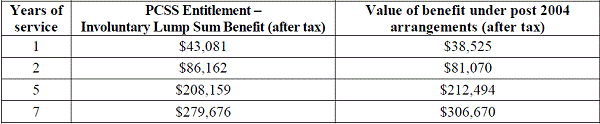
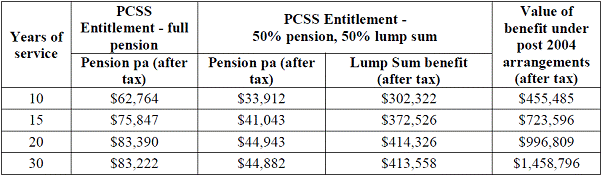
The Department of Finance and Deregulation was asked to prepare a
practical comparison between the pre- and post-2004 arrangements. The
department provided the following instructive example which demonstrates that
under this specific scenario there is little difference between the superannuation
entitlements payable under the two schemes. The assumptions used to generate
this example include, that the MP:
the post-2004 member had:
-
received employer contributions of 15.4 per cent per annum (notwithstanding
that Superannuation Guarantee was introduced progressively from 1992);
-
salary sacrificed an amount each year equivalent to the after tax
contribution of 11.5 per cent (or 5.75 per cent after 18 years of service) made
by a member in the PCSS;
-
15 per cent contributions tax on employer contributions was
applied; and
-
a fund earnings rate, after investment fees and taxes, of 6 per
cent.
1.35
The full list of assumptions is reproduced in Appendix 2.
Table 1—Comparison
of pre- and post-2004 arrangements (less than 8 years service)
Source: Department of Finance and Deregulation, answer to
question on notice, 11 September 2009, p. 3.
Table 2—Comparison of pre- and post-2004 arrangements
(10–30 years service)
Source: Department of Finance and Deregulation, answer to
question on notice, 11 September 2009, p. 3.
1.36
The department acknowledged that 'the above results are dependent on
specific assumptions. Changes to any of the assumptions listed above may lead
to a significant change in the results.'[30]
1.37
Despite the above example which shows a large degree of similarity
between the benefits accrued under the two arrangements, a number of
commentators have expressed the view that the benefits provided under the two
schemes are not equivalent. The Parliamentary Library has observed that the post-2004
arrangements are 'far less generous than the PCSS scheme.'[31]
The Library's 2006 report goes on to note that the Commonwealth’s notional
contribution to the PCSS is about 70 per cent of a parliamentarian’s income
whereas the comparable rate under the new arrangements is 15.4 per cent.[32]
1.38
Another significant difference between the pre- and post-2004
arrangements is death and invalidity benefits. The benefits under the PCSS are
well defined, for example death benefits equal to five sixths of the rate of
pension that the deceased member was being paid or would be entitled to, is
payable to an eligible partner.
1.39
By contrast the post-2004 arrangements will vary from MP to MP depending
on which superannuation fund they choose, as it depends on the nature of the
insurance arrangement for the particular superannuation scheme that the member
is in. Typically, death benefits will equate to the amount in the member's
account plus any applicable death cover. The Department of Finance and
Deregulation's comparison of the death and invalidity benefits provided by the
PCSS and AGEST is reproduced in Appendix 3.
Committee view
1.40
The committee notes that while the two sets of arrangements are
inherently difficult to compare, the new arrangements have aligned the
superannuation entitlements of MPs elected post-2004, much more closely with
the arrangements of the majority of Australians.
Navigation: Previous Page | Contents | Next Page