192 Reply
-
A reply may be made by a senator who has made a substantive motion to the Senate on which debate is allowed, but not by a senator who has moved an amendment or the previous question.
-
The reply of the mover of the original question shall close the debate.
Amendment history
Adopted: 19 August 1903 as SOs 402 and 403 (corresponding to paragraphs (1) and (2)) but renumbered as SOs 397 and 398 for the first printed edition
Amended: 11 June 1914, J.79 (paragraph (1) amended to add the qualification “on which debate is allowed”)
1989 revision: Old SOs 411 and 412 combined into one, structured as two paragraphs and renumbered as SO 192; superfluous material removed, such as a previous reference to moving “any reading of a Bill” in addition to a substantive motion; language modernised and expression streamlined
Commentary
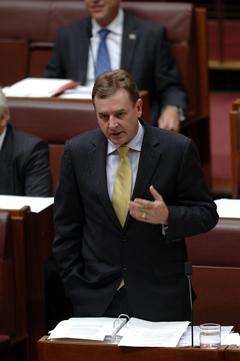
Ministers commonly speak in reply to the secing reading debate on a bill. The reply closes the debate (Photo courtesy of AUSPIC)
A right of reply on a substantive motion allows the mover to answer questions and debating points that have been posed during the debate and to make the final case for the motion. A reply is not confined to this purpose, however, and, as with any speech on a motion, the only restriction on content is relevance.
The right of reply is confined to “substantive” motions which have been distinguished by Presidential rulings from procedural motions, such as motions for the recommittal of a bill or an instruction to a committee.[1] A motion for a reading of a bill is clearly a substantive motion and a superfluous reference to such motions was removed in the course of the 1989 revision. Other motions which have been characterised in practice as procedural motions include the following:
-
to suspend standing orders;
-
for items of business to have precedence till determined;[2]
-
to take bills together;
-
for bills to proceed without formalities.
A reply is not permitted on an amendment or on the previous question (see SO 94).
See SO 186 for the rule that senators who would otherwise be entitled to the call under the practices of the Senate are discouraged from seeking it where they would close the debate and other senators wish to speak.
See Odgers’ Australian Senate Practice, 12th edition, pp.215–16 for further analysis.