182 Witnesses before the Senate
The examination of a witness before the Senate shall be conducted in accordance with procedures adopted by the Senate for the purpose.
Amendment history
Adopted: 19 August 1903 as SOs 382 to 385 but renumbered as SOs 378 to 381 for the first printed edition
1989 revision: Old SOs 392 to 395 combined into one and renumbered as SO 182; prescriptive content removed and replaced with a generalised rule
Commentary
This standing order is an amalgamation of a number of the original standing orders dealing with the examination of witnesses. They covered a range of matters including some that could be regarded as protocol issues, for example where the bar of the Senate should be during the examination of a witness (“kept down”). They also set out one procedure for the Senate (witnesses to be examined by the President and questions from other senators to be asked through the President) and another for committee of the whole (any senator may question the witness directly). The procedures were modelled entirely on the standing orders of the South Australian House of Assembly. All detail disappeared in the 1989 revision to be replaced by the capacity for the Senate to adopt a procedure on a case by case basis. See SOs 35 and 38 for other cases where prescriptive and outmoded details of process were deleted in the 1989 revision.
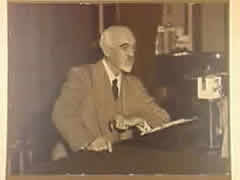
Sir Robert Gibson, Chairman of the Commonwealth Bank Board, who gave evidence at the bar of the Senate in 1930 on the Commonwealth Bank Bill (although he was actually invited onto the floor of the Senate)(Source: National Library of Australia)
Witnesses have been called to the bar of the Senate on only two occasions: Sir Robert Gibson, Chairman of the Commonwealth Bank Board in 1931 [1]; and, in 1975, in connection with the notorious overseas loans negotiations.[2]
The appearance by Sir Robert Gibson before the Senate to give evidence on the Commonwealth Bank Bill followed the standing orders, except that, with the concurrence of senators, Sir Robert was admitted to the floor of the Senate and to a seat at the end of the Table.[3] Before questioning commenced, President Kingsmill explained the procedure required by standing orders and how he intended to proceed. All questions would be addressed through him, as the President, and he would not allow any question that was not relevant to the terms of the bill. He further indicated that each senator would have the call in turn until completing his questions and then only given the call again if leave of the Senate were obtained. Points of order were frequently raised and, as the questioning became more heated, Senator Dunn (Lang Lab, NSW) accused the opposition of a “frame-up” in bringing Sir Robert before the Senate for the purpose of political propaganda. Dunn was suspended for refusing to obey the Chair and withdraw the objectionable words, while Sir Robert, a model witness, remained quietly at the Table. President Kingsmill apologised for the “scene” and questioning of the witness continued.[4]
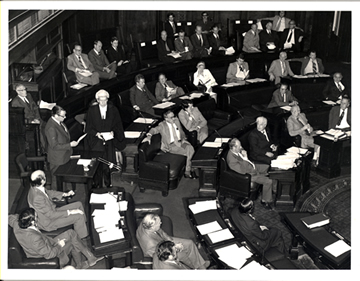
ir Frederick Wheeler taking the oath at the bar of the Senate in 1975 (administered by the Clerk, J.R. Odgers) in relation to the overseas loans affair. On instruction, Wheeler, along with all other public servants summoned by the Senate, claimed Crown Privilege (Source: Government Information Service)
In July 1975, senior public servants including Sir Frederick Wheeler, Mr John Stone, Sir Lenox Hewitt, Mr Clarrie Harders, Mr Maurice Byers, Mr Andrew Menzies, Mr Peter Bailey and Mr Dennis Rose (among others), were summoned to the bar of the Senate to provide information about the overseas loans negotiations. The day they were due to appear, letters from the Prime Minister, Gough Whitlam, relevant ministers and the Solicitor-General were read by President O’Byrne and tabled, making claims of Crown privilege (now called public interest immunity) in respect of all evidence to be sought from the witnesses in relation to the loans affair.[5] The following day, the Senate affirmed its powers to require persons to appear and produce documents, and its right to determine claims of privilege.[6] The witnesses were in attendance but before they were called and sworn a motion setting out procedures for their examination was moved by the Leader of the Opposition in the Senate, Senator Withers (Lib, WA). In proposing a detailed set of rules for the examination of witnesses, he argued that the existing standing orders were “not up to date or altogether satisfactory”, that they had not really been followed in the examination of Sir Robert Gibson and that the examination of Fitzpatrick and Browne by the House of Representatives in 1955 was not a model that the Senate wished to emulate.[7] The motion was carried by a small majority and the examination of witnesses proceeded, punctuated by points of order, with all witnesses indicating that they intended to obey ministerial directions and claim Crown privilege in respect of all relevant evidence.[8]
A further witness was examined on 22 July 1975, Mr Gerasimos Karidis, an agent for Mr Tirath Khemlani, the businessman at the centre of the overseas loans controversy. A further resolution of the Senate allowed Mr Karidis to be accompanied by, and to consult, counsel. Mr Karidis made a statement to the Senate and presented numerous documents. Questioning then proceeded, again, not without controversy.[9]
In both cases the tension of the subject matters spilled over to the conduct in the Senate. The absence of some detail in the standing orders was evident in Sir Robert Gibson’s appearance – for example, for how long each senator could ask questions of the witness. This was addressed in the procedures agreed to by the Senate in 1975. The revised standing order provides the framework for a similar model to be adopted in any future case.