179 Requests from the House of Representatives
If the House of Representatives requests by message the attendance of a senator or an officer of the Senate before the House of Representatives or a committee, the Senate may authorise the senator or officer to attend.
Amendment history
Adopted: 19 August 1903 as SO 378 but renumbered as SO 374 for the first printed edition
1989 revision: Old SO 388 renumbered as SO 179; expression considerably streamlined
Commentary
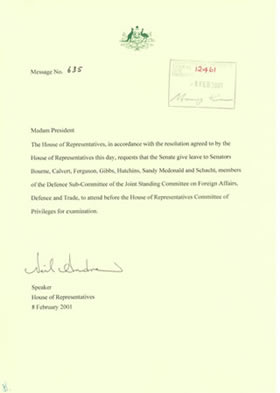
An example of a message from the House of Representatives seeking the appearance of senators before a House of Representatives committee
As adopted in 1903, the standing order made no mention of a senator or officer of the Senate appearing before the House of Representatives itself. This possibility was included, however, in the 1989 revision. It has been suggested that the “early Senate may have taken the view that its independence was best served by not recognising the proposition that it might authorise its members to be examined by members of another place”.[1] Whatever the case, the position was normalised in the revision.
While senators may appear on a voluntary basis as witnesses before House committees to provide their views on particular inquiries, the procedure set out in the standing order is still used for inquiries that examine the conduct of individuals, investigate disputed matters or where adverse findings are possible. It has been used, for example, by the House of Representatives Privileges Committee when investigating matters involving the unauthorised disclosure of proceedings of a joint committee administered by the House.[2]
On the most recent occasion, a motion under this standing order authorising senators to appear before the House of Representatives Privileges Committee included the proviso that such authorisation is “subject to the rule, applied in the Senate by rulings of the President, that one House of the Parliament may not inquire into or adjudge the conduct of a member of the other House”.[3] This is a fundamental principle of parliamentary privilege.