178 Members or officers of the House of Representatives
When the attendance of a member or officer of the House of Representatives is required by the Senate or a committee a message shall be sent to the House of Representatives requesting that the House of Representatives give leave to the member or officer to attend.
Amendment history
Adopted: 19 August 1903 as SO 377 but renumbered as SO 373 for the first printed edition
1989 revision: Old SO 387 renumbered as SO 178; expression streamlined
Commentary
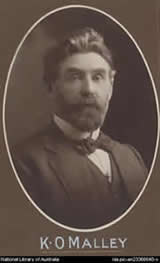
King O'Malley (ALP) member for Darwin (Tasmania) appeared twice before Senate select committees pursuant to request made under SO 178 (Source: National Library of Australia)
Unchanged in substance since its adoption in 1903, SO 178 nonetheless underwent some revision of expression in 1989. One point of modernisation was the deletion of the reference to “a Committee on a Private Bill”. The terms “Public Bill” and “Private Bill” had been taken straight from the South Australian standing orders and had never had any meaning in the Commonwealth Parliament in the absence of any provision for “Private Bills” in the Constitution. As noted in the 1938 MS, all bills dealt with by the Commonwealth Parliament are “Public Bills” and the distinction is unnecessary.
The standing order has been used periodically, most frequently between 1904 and 1913. In those years several requests were made to the House of Representatives, relating to five separate inquiries, for the authorisation of members to appear as witnesses, including Prime Minister Joseph Cook on two occasions. The House of Representatives did not always authorise the requested members to attend.[1]
On 7 March 2001, in debate on a motion (under SO 179) authorising senators to appear before the House of Representatives Committee of Privileges, Senator Ray (ALP, Vic) indicated that, in similar cases, the Senate Privileges Committee usually decided “not to call any … House of Representatives members … based on what we regard as the comity between the houses”. He went on to express the view that such requests should occur only when it was “absolutely necessary and not as a matter of form”, indicating that his view was “reinforced if the question of ministers comes up” because of the potential for partisan discord.[2]
On many occasions, House of Representatives members, including ministers, have appeared before Senate committees on a voluntary basis to give their views on certain inquiries. For details see Odgers’ Australian Senate Practice, 12th edition, pp.426–29.