173 Presentation of message
-
A message from the Governor-General shall be reported to the Senate by the President as soon as practicable after its receipt.
-
A message from the Governor-General may be presented to the Senate by a minister at any time, but not during a debate, or so as to interrupt a senator speaking.
-
The message may be at once taken into consideration, or ordered to be printed, or a future day may be fixed for taking it into consideration.
Amendment history
Adopted: 19 August 1903 as SOs 362, 365 and 366 (corresponding to paragraphs (1), (3) and (2) respectively) but renumbered as SOs 358, 361 and 362 for the first printed edition
1989 revision: Old SOs 372, 375 and 376 combined, reordered, structured as three paragraphs and renumbered as SO 173; prescriptive and superfluous detail removed
Commentary
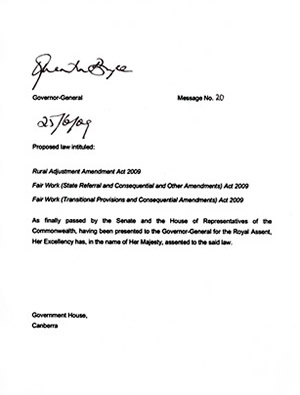
A message from the Governor-General notifying her assent to laws is reported in the Senate
Part of a slightly longer series, the precursors to SO 173 reflected the practices of the South Australian House of Assembly where messages from the Governor were delivered by a representative in person, announced by the Serjeant-at-Arms, collected from the bar by the Clerk and handed directly to the Speaker to be read to the Assembly (while members took off their hats!). A message reported by this method interrupted the business before the Assembly. Alternatively, a message from the Governor could be reported by a minister from his seat in the chamber, provided it did not interrupt a debate or a member speaking.[1]
The underlying rationale is the provision of a communication channel between constituent parts of the parliament, from the governor to a house via its presiding officer, or between two of the arms of government, from the executive to the parliament via a minister.
When adapting colonial practices for its purposes, the Senate strengthened the separation between executive and parliament under the alternative method, by providing for a minister to present a message from the bar of the Senate, rather than from within the chamber. It also dispensed with the doffing of hats during the reporting of a message by the President.
It is apparent that the procedures set out in the standing orders were quickly streamlined. Messages were generally reported between items of business and did not, therefore, interrupt business in practice. While Edwards compiled no notes on these standing orders, Odgers’ antiquarian researches unearthed three occasions on which the Governor-General came in person to hand over messages assenting to laws, although the real purpose of his visits was to prorogue the Parliament.[2] For the most part, however, messages were delivered through “the ordinary departmental delivery channels”. In 1917, the Leader of the Government in the Senate, Senator Pearce (Nat, WA), challenged President Givens for reporting a message (handed to him by the Clerk) from the Governor-General assenting to laws, on the ground that ministers usually reported such messages. Givens delivered a lengthy ruling on 15 February 1917 referring to the Governor-General’s adoption of a common sense system for messages to be forwarded directly to the Clerk, “I suppose to save time, and to get rid as far as possible of tedious formalities”. Givens did not see why ministers should interfere between a Clerk and his President and found the Governor-General’s system to be entirely in accordance with the standing orders, directing that it be adhered to in future unless otherwise ordered by the Senate.[3] A message of this nature is a communication between components of the parliament, in any case, and it would be highly inappropriate for the executive to intervene as an intermediary.
The 1989 revision stripped the standing order of superfluous and prescriptive detail that did not, in any event, reflect the actual practices of the Senate over many decades. In particular, the explanatory notes tabled with the first draft of the revision suggested for deletion the provision for receipt of a message from the Governor-General to interrupt proceedings, on the ground that it was not now followed.[4] As a result of the revision, the standing order now provides two methods for the presentation of messages and options for their consideration if required. The chief method is for messages to be reported by the President but the capacity for ministers to report messages has been retained.
In theory, messages from the Governor-General may include the following matters:
-
replies to addresses from the Senate;
-
assent to laws;
-
proclamations notifying the commencement of Acts or provisions of Acts, or other proclamations required by statute to be made by the Governor-General and laid before both Houses;[5]
-
messages recommending appropriations under s. 56 of the Constitution;
-
other messages under s. 58 of the Constitution – withholding assent to laws, reserving laws for assent by the Queen or recommending an amendment.
In practice, only the first two types are received. Since the commencement of the Legislative Instruments Act 2003, proclamations notifying commencement of Acts or parts thereof are defined as legislative instruments (although they are not disallowable)[6] and are tabled as so-called Clerk’s documents. See SO 166 for documents tabled pursuant to statute. Messages recommending an appropriation relate to the financial initiative of the executive and would therefore be suitable candidates for reporting by ministers. For constitutional reasons, however, they are not produced in the Senate.[7] Other messages under s. 58 of the Constitution are virtually obsolete.[8]