143 Appointment of committee
-
A committee of the whole shall be appointed by a resolution that the Senate resolve itself into a committee of the whole, immediately or at a future time.
-
When an order of the day is read for the Senate to resolve itself into a committee of the whole the President shall leave the chair without putting any question, and the Senate then resolve itself into committee, unless on notice an instruction to the committee is proposed.
Amendment history
Adopted: 19 August 1903 as SOs 252 and 253 (corresponding to paragraphs (1) and (2)) but renumbered as SOs 248 and 249 for the first printed edition
1989 revision: Old SOs 260 and 261 combined into one, structured as two paragraphs and renumbered as SO 143; an unused provision for the President to put the question that he leave the chair was deleted; language modernised and expression streamlined
Commentary
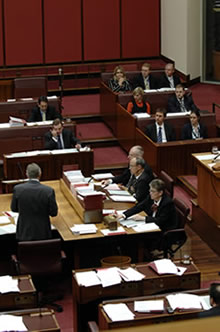
A committee of the whole stage on a bill. The committee is chaired from the chair at the table between the clerks (Phote courtesy of AUSPIC)
All committees belong to one of two types. They are either committees of the whole assembly or select committees in the generic sense. Select committees, by definition, comprise a selection of senators.[1] Committees of the whole have their origins in 17th century English parliamentary practice and struggles with the monarch, particularly over expenditure. The point of committee of the whole was apparently to remove the Speaker (regarded as the King’s man) from the deliberations and replace him with a trusted parliamentarian who would not betray members’ thinking to the King.[2] Matters affecting finance could only be discussed in committee. By the time of Federation, the procedure had been copied by the colonial assemblies as a useful way of examining matters, particularly bills, in detail. Its origins, however, were of so little relevance to contemporary practices that President Baker could report to the Senate, when it was first considering the need to appoint a Chairman of Committees, that he himself had done “double duty” in both roles for years as President of the Legislative Council of South Australia and did not see any problem with it.[3]
The most common use of committee of the whole proceedings is for the consideration of bills after their second reading. Standing Order 115 provides for the immediate and automatic consideration of bills in committee of the whole after their second reading unless:
- the bill has been referred to a standing or select committee; or
- there are no proposed amendments to the bill and no senator wishes to have a committee stage for the purpose of raising matters about the bill (see SO 115).
For matters other than bills to be considered in committee of the whole, paragraph (1) provides the mechanism. Committee of the whole proceedings have been used to consider reports of the Standing Orders Committee,[4] the Advance to the Minister for Finance[5] and other documents.[6]
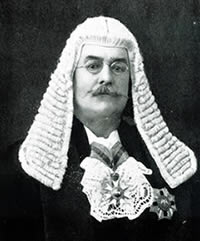
President Baker had done 'double duty' in the South Australian Legislative Council and queried the need for a separate Chairman of Committees (Source: Commonwealth Parliamentary Handbook)
Being familiar to the majority of the first senators, 75 per cent of whom had previous parliamentary experience, the committee of the whole procedures, with one exception, attracted very little debate in 1903.[7] What debate there was followed a lengthy discussion on the question that the standing orders relating to requests be postponed, which ended in a series of testy exchanges between President Baker and his state and party colleague, Senator Symon (FT, SA).[8] The two were often at odds during these debates on rules for aspects of the legislative process. Symon argued that paragraph (1) was incomplete and moved an amendment to add:
…and if immediately, then the President shall put the question: “That the President do now leave the Chair”, which being agreed to, he shall leave the chair accordingly.[9]
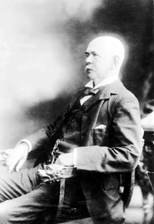
Senator Josiah Symon (FT, SA) argued with Baker over the mechanism for going into committee of the whole (Source: National Library of Australia)
No-one demurred, possibly stung by Symon’s recent sledging of other senators for speaking too much, and the amendment was agreed to without further debate. It was an unnecessary addition because the decision to go into committee immediately would already have been made by the resolution provided for in the original version of the standing order. To put a further question, “That the President do now leave the chair” was, in effect, making the same decision a second time. In the 1938 MS, Edwards tells us that “in actual practice the resolutions referred to in this Standing Order are not formally put to the Senate”. He goes on to explain that this was because they were not necessary precursors for considering bills in committee, but that if a committee should be appointed for some other purpose they would then be required. Perhaps Edwards was being optimistic. By the time of the 1989 revision, the procedure added by Senator Symon’s 1903 amendment was suggested for deletion because it had “not been followed”.[10]
When an order of the day for consideration of any matter in committee is read by the Clerk, the Chair leaves the President’s chair and occupies the chair at the table between the two clerks. This is the visible sign that the Senate is “in committee”.