129 Requests
-
If requests for amendments in a bill have been made (whether in addition to amendments or not), the requests shall, upon the conclusion of the committee’s proceedings, be reported to the Senate, and upon the adoption of the report a message shall be sent to the House of Representatives requesting the House to make amendments in the bill in accordance with the requests, and returning the bill.
-
On the disposal of such requested amendments in accordance with the standing orders, the bill shall be read a third time, and, if the Senate has made amendments in the bill, the procedure with respect to amendments shall be followed.
Amendment history
Adopted: 9 September 1909, J.121, as SO 224A (to take effect 1 October 1909) (corresponding to paragraphs (1) and (2)) but renumbered as SO 227 for the 1909 edition
1989 revision: Old SO 232 restructured as two paragraphs and renumbered as SO 129; language modernised and expression streamlined
Commentary

Charles Boydell, Clerk of the Senate 1908-17, author of the first reference work on the Senate's powers under section 53 of the Constitution (Source Commonwealth Parliamentary Handbook)
Section 53 of the Constitution provides that certain types of bills may not be initiated in or amended by the Senate. In addition, the Senate may not amend bills if the impact of the amendment would be to increase the proposed charge or burden on the people. In these situations, the Senate may request the House of Representatives to make particular amendments. The standing orders adopted in 1903 provided procedures for amendments (see, for example, SOs 118, 131, 132 and 134) and for requests (see SOs 140 and 141). Not initially covered, however, was the situation in which the Senate made both amendments and requests to the same bill. This occurred in relation to the Sugar Bounty Bill 1903 which was the subject of complex and protracted proceedings.
As the debate on the adoption of this standing order in 1909 demonstrates, there had been some initial uncertainty as to whether it was competent for the Senate to make both amendments and requests to the same bill.[1] Senator Pearce (ALP, WA) gave credit to then Clerk, C. B. Boydell, for guiding the drafting of the proposed standing order:
Mr Boydell has made a special study of the difficulties into which we have got in regard to composite Bills. It was pointed out that we had no definite procedure in regard to them. But we have established a practice, and it is now sought to embody that practice in a standing order.[2]
The practice had been suggested by the Senate as a result of proceedings on the Sugar Bounty Bill in 1903. Boydell would develop his notes on the subject and produce a small booklet, Notes on the Practice and Procedure of the Senate in relation to Appropriation, Taxation, and Other Money Bills; together with Standing Orders and Presidents’ Rulings; also a Summary of Cases Referred to (1901 –1910), tabled by President Turley and ordered to be printed on 6 September 1911.[3] This was the first of a distinguished body of clerkly writings to be presented to the Senate.
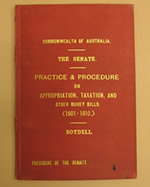
Noydell's small booklet on the powers of the Senate, the first of many scholarly writings by Senate clerks
Detil from Boydell's booklet on the powers of the Senate
The practices which were reflected in the new standing order were considered to preserve the powers of the Senate while at the same time being fair to the House of Representatives by providing it with a full picture of the Senate’s views on the bill. The following steps are involved when a bill is reported out of committee with amendments and requests:
-
After the report of the committee is adopted, the bill is not read a third time.
-
The bill is returned to the House with a message requesting the House to amend the bill in accordance with a schedule of requests. A schedule of the amendments made by the Senate is also included for the information of the House.
-
When the requested amendments have been made or a position otherwise acceptable to the Senate has been reached and a message received from the House accordingly, the bill is then read a third time in the Senate.
-
The bill is again returned to the House with a message seeking the concurrence of the House in the Senate’s amendments, and the usual procedures with respect to amendments are then followed.
The first message takes the following form:
Message No.
Mr Speaker
The Senate returns to the House of Representatives the bill for <Long Bill Title>, and requests the House to make the amendments in schedule A annexed.
The Senate informs the House that it has also made the amendments in schedule B annexed.
President
The Senate
<date>
[<short title of the bill>]
The second message includes the following paragraphs:
The Senate returns to the House of Representatives the bill for <Long Bill Title>, and informs the House that the Senate has agreed to the bill as amended by the House at the request of the Senate, with the amendments in the annexed schedule.
The Senate requests the concurrence of the House in the amendments.