122 Third reading
-
When the report of the committee of the whole is adopted, a future day shall be fixed for the third reading.
-
When the order of the day for the third reading of a bill is called on, the question shall be proposed – That this bill be now read a third time.
-
An amendment may be moved to that question by leaving out “now”, and adding “this day 6 months”, which, if carried, shall finally dispose of the bill. No other amendment may be moved to the question for the third reading.
-
After the third reading no further question shall be put, and the bill shall be taken to have been passed by the Senate.
Amendment history
Adopted: 19 August 1903 as SOs 207, 210, 211 and 212 (corresponding to paragraphs (1) to (4)) but renumbered as SOs 206 and 209–11 for the first printed edition
1989 revision: Old SOs 213, 216, 217 and 218 combined into one, structured as four paragraphs and renumbered as SO 122; a reference to the previous question removed from paragraph (3) (covered elsewhere) and a prohibition on any other amendment added; language modernised
Commentary
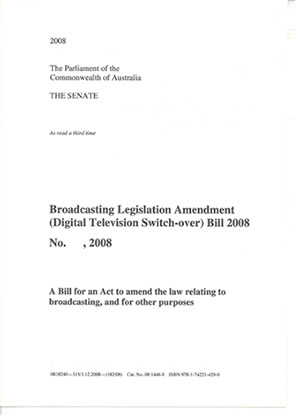
A bill as read a third time
Like many other standing orders in this chapter, this group was adopted without debate, having been drawn from South Australian and NSW models, except for paragraph (4) which was the practice of the House of Commons (one of very few such attributions).[1]
Paragraph (1) is one of those standing orders that are suspended by the operation of the expedited proceedings under SO 113 because it provides for a future day to be appointed for the third reading of a bill after the adoption of the report of the committee of the whole.
See Odgers’ Australian Senate Practice, 12th edition, Chapter 12, under “Third reading” for comments on the scope of debate permitted at this stage.
As is the case with a similar amendment moved to the second reading motion, paragraph (3) provides that an amendment to leave out the word “now” and substitute “this day 6 months” is taken to finally dispose of the bill. See commentary under SO 114. Amendments of this type are now rare and sometimes misunderstood to have a literal meaning.[2]
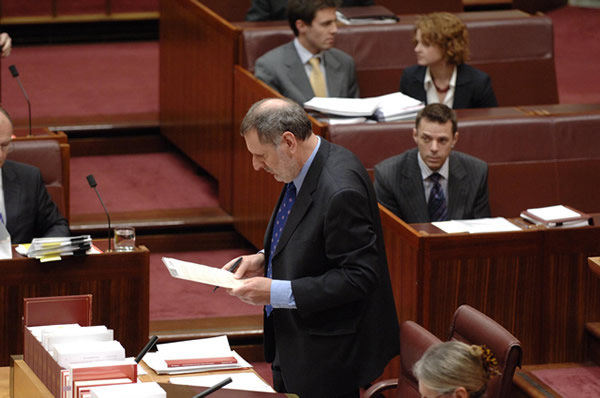
The Clerk reads the title of the bill after each stage has been agreed to. This acknowledges the function of clerks in previuos ages to read the bill aloud from cover to cover at each stage to facilitate deliberation (Photo courtesy of AUSPIC)
Whereas other amendments are permitted to be moved to the motion for the second reading, provided they are relevant to the bill, no other amendments are permitted to be moved to the third reading motion. This prohibition was adopted in the course of the 1989 revision and made explicit a rule implicit in Presidential rulings that having allowed a bill to pass through all previous stages, the Senate must either pass it or decline to pass it. No other course is rationally open to it.[3]