120 Report from committee
-
When the consideration of a bill in committee of the whole has been concluded the question shall be put that this bill (or this bill as amended) be reported, and if that question is agreed to the chairman shall leave the chair and report the bill forthwith.
-
On the motion that the bill be reported the reconsideration of any clauses may be moved as an amendment.
-
If a bill is reported with amendments a future day shall be appointed for taking the report into consideration and moving its adoption, and the bill, as reported, shall be printed, but if no amendments have been made the report may be at once adopted.
Amendment history
Adopted: 19 August 1903 as SOs 203 (corresponding to paragraphs (1) and (2)) and 205 (paragraph (3)) but renumbered as SOs 202 and 204 for the first printed edition
1989 revision: Old SOs 209 and 211 combined into one, structured as three paragraphs and renumbered as SO 120; language modernised and streamlined
Commentary
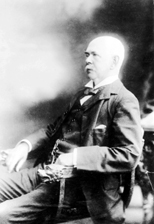
Senator Josiah Symon (FT, SA) made a significant contribution to the 1903 debate on standing orders dealing with legislation, often clashing with President Baker (Source: National Library of Australia)
Paragraph (2) was not part of the original standing orders as proposed by the Standing Orders Committee but was the consequence of an amendment moved by Senator Symon (FT, SA) to SO 117(2) to preserve the South Australian practice of allowing for the reconsideration of a bill before it had been reported out of committee.[1] Once the principle had been established, Senator Symon wanted to insert a new standing order to provide the mechanism for reconsideration but was prevented by the chair from doing so and advised to move it as an amendment to original SO 203.[2] The 1989 revision restored Senator Symon’s intended structure by recasting the amendment as a self-contained rule. A proposal to reconsider any clauses may be moved at the end of the committee stage as an amendment to the motion that the bill be reported. An amendment of this type is drafted to supersede the motion to report the bill.
Paragraph (3) is one of those standing orders that are suspended by the operation of the expedited proceedings under SO 113 because it provides for a future day to be appointed for the consideration of the report of the committee of the whole when the committee has made amendments to a bill. The reason for this delay was a practical one because it allowed a fair print to be made of the bill, as reported, so that senators could see it in the amended form before deciding whether to adopt the committee’s report. Indeed, the standing order requires a reprint in this situation. The delay does not apply where the bill is not amended. Under earlier practices, the use of suspensions of standing orders to eliminate these formal delays in the passage of bills was also taken to suspend the requirement for reprinting the bill.[3]
The 1989 revision provided an opportunity to remove a rule which had originated as SO 204 and provided for the Chairman of Committees to carry out various administrative tasks such as certifying the bill and amendments. These practices had not been adhered to for many years and were the kind of task required elsewhere in the standing orders to be carried out by the Clerk. The suggestion for deletion was adopted.[4]
For the mechanics of reporting out of committee of the whole, see SO 148.