118 Amendments in committee
-
An amendment may be made to any part of a bill, provided it is relevant to the subject matter of the bill and otherwise in conformity with the rules and orders of the Senate.
-
No new clause or amendment shall be proposed which is substantially the same as one already negatived by the committee, or which is inconsistent with one that has been agreed to by the committee, unless a recommittal of the bill has intervened.
-
If a clause is amended, a further question shall be put, that the clause stand as amended.
-
If an amendment has been made in the bill, not coming within the original title, the title shall be amended, and that amendment shall be specially reported to the Senate.
Amendment history
Adopted: 19 August 1903 as SOs 195, 196, 198 and 200 (corresponding to paragraphs (1) to (4)) but renumbered as SOs 194, 195, 197 and 199 for the first printed edition
1989 revision: Old SOs 201, 202, 204 and 206 combined into one, structured as four paragraphs and renumbered as SO 117; language modernised and superfluities removed
Commentary

Many amendments to a bill may be circulated by different senators
This standing order brings together four original standing orders dealing with amendments to a bill in committee of the whole. Following the debate referred to in the previous standing order with respect to SO 117(2), senators in 1903 postponed their decision on paragraph (2) above, initially believing it to require either amendment or abandonment in consequence of the changes to SO 117(2). It was subsequently agreed to on 12 August without amendment, President Baker having explained its rationale as a safeguard against unfairness:
Our present practice is that a matter may be reconsidered in the same Committee without a report [SO 117(2)]. That practice has its advantages, but it also has great disadvantages. One advantage is that on the same evening those who have a majority can reverse decisions formerly arrived at; but one great inconvenience and unfairness involved is that no notice is given to honourable senators present that it is proposed to reverse decisions which the Committee has already arrived at. It was that unfairness which led the Standing Orders Committee to propose this standing order as it now stands.[1]
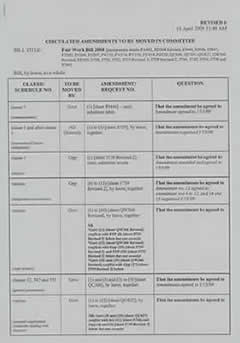
A running sheet is a marshalled list of those amendments to assist the committee to work it's way through them all in a logical order
The requirement for a recommittal of the bill before a decision of a previous committee could effectively be reversed was the equivalent of giving notice to senators and was therefore a fundamental parliamentary safeguard.
SO 118(1) reflects the important principle that President Baker had attempted to establish in relation to SO 111 ; namely, that relevance should be determined by reference to the subject matter of a bill rather than its title alone. Here it was appropriately applied to amendments and was adopted without debate, as was paragraph (4) which demonstrates that the title of a bill does not limit its contents because the title may be amended if amendments made to the bill exceed the scope of the original title. Note, however, that amendments which are not relevant to the subject matter of a bill in the first place, cannot be made relevant by a subsequent amendment to the title.[2]
The long titles of bills are not frequently amended, doubtless due to the practice noted by Senator Symon (FT, SA) in 1903 for parliamentary drafters to include the words “and for related [or other] purposes” at the end of them.[3] When amendments are made to the title, this fact is reported separately in the report from the committee of the whole.
The form of the question prescribed in paragraph (3) for clauses as amended is consistent with the constitutional requirements for voting in the Senate referred to under SO 116.