90 Moving of amendments
-
A question having been proposed may be amended:
-
by leaving out words;
-
by leaving out words in order to insert or add words; or
-
by inserting or adding words.
-
An amendment to a question must be in writing and signed by the proposer.
-
An amendment must be relevant to the question to which it is proposed to be made.
-
The mover of a motion or a senator who has spoken in the debate may not move an amendment, and a senator may not move more than one amendment to a question.
Amendment history
Adopted: 19 August 1903 as SOs 130, 131 and 132 (corresponding to paragraphs (1) to (3))
1989 revision: Old SOs 137 – 139 combined into one, structured as three paragraphs and renumbered as SO 90; paragraph (4) added to make explicit an implicit rule; minor superfluities removed
Commentary
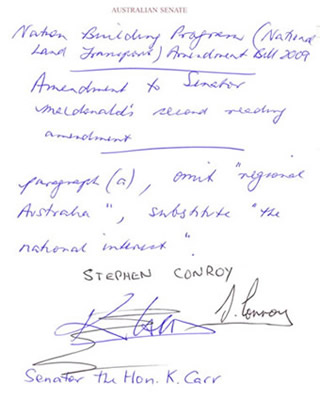
An ammendment must be in writing and signed by the proposer. Some ammendments, like this one, are done on the floor of the chamber and are handwritten
The moving of amendments to motions is a fundamental element of parliamentary procedure. Virtually unchanged since its adoption, SO 90 is one of those self-explanatory sets of rules that the Standing Orders Committee would have seen as reflecting universal practice in the state parliaments, and therefore to be included so as to ensure the standing orders of the Senate contained, as far as possible, a complete code of procedure.[1]
In the same spirit, paragraph (4) was added in the 1989 revision to express implicit procedural rules that had been expounded by Presidential rulings from the earliest times; in this case, the rule that a senator may be called only once in each debate.[2] For the sake of comprehensiveness, these rules were explicitly stated in the new paragraph.[3]
Most amendments are drafted in advance and multiple copies are circulated in the chamber on the authority of the proposer. Amendments formulated on the floor may be handwritten and circulated in limited copies only, if at all. The rule in paragraph (2) is not enforced where an amendment is simple and easily understood.[4] The 1938 MS lamented this practice, urging that it was “very desirable that it should be strictly enforced. It frequently happens, however, that slight alterations have to be made to the written and signed amendment to place it in order”. Nothing has changed.