General committee provisions
35 Witnesses
-
The examination of witnesses before a committee shall be conducted by the members of the committee in accordance with procedures agreed to by the committee, subject to the rules of the Senate.
-
The examination of witnesses shall be recorded in a transcript of evidence.
Amendment history
Adopted: 19 August 1903 as SO 296 (corresponding to paragraphs (1) and (2)) but renumbered as SO 292 for the first printed edition.
1989 revision: Old SO 304 restructured as two paragraphs and renumbered as SO 35; repositioned from old chapter XXII on select committees; expression significantly streamlined and language modernised
Commentary
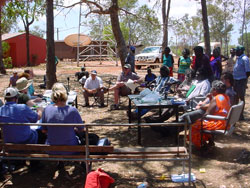
The Select Committee on Regional and Remote Indigenous Communities taking evidence from witnesses at Elcho Island, in northeast Arnhem Land, NT
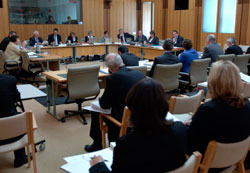
The Rural and Regional Affairs and Transport Legislation Committee taking evidence from witnesses in Parliament House (Photo courtesy of AUSPIC)
In its 1903 form, which was based on South Australian House of Assembly SO 364 and which remained untouched until the 1989 revision, SO 35 was highly prescriptive. Examination of all witnesses was to occur in accordance with the following procedures:
…the Chairman shall first put to the Witness, in an uninterrupted series, all such Questions as he may deem essential, with reference either to the subject referred to therein, or to any branch of that subject, according to the mode of procedure agreed on by the Committee. The Chairman shall then call on the other Senators severally by name to put any other Questions which may have occurred to them during his conduct of the examination; and the name of every Senator so interrogating a Witness shall be noted and prefixed to Questions asked. All replies to Questions put shall be in writing; but if the committee be attended by a shorthand writer, the notes of such shorthand writer shall be sufficient.
Extensive revision of the standing order in 1989 can be attributed to the passage of the Privilege Resolutions on 28 February 1988 which included Privilege Resolution 1, “Procedures to be observed by Senate committees for the protection of witnesses”. These detailed procedures incorporated principles of procedural fairness and were therefore much more comprehensive than the process approach contained in the original standing order. The revised standing order left it to individual committees to determine how they would conduct hearings, subject to the rules of the Senate. For example, committees could decide to examine a particular witness by teleconference or video link (see SO 30), or allocate time limits to each senator for asking questions, or for particular subjects, when the time available was limited.
A transcript is required of all evidence taken by a committee, whether in public session or in camera.
See SOs 176–83 on witnesses.